
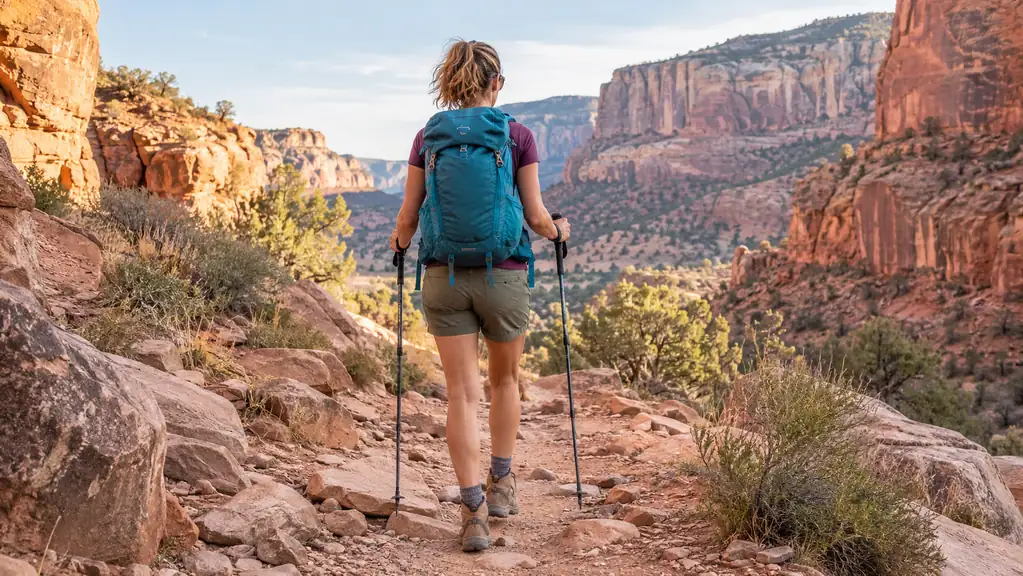
My left knee started complaining on downhills about six years ago. Not on the climb. Never on the climb. It was always the last mile down from a viewpoint at Red Rock Canyon, that spot where the trail tips forward and your whole body weight lands on one leg at a time, over and over, until something in there decides it has had enough.
For a while I did the thing most people do. I walked slower. I stepped sideways down the steep parts, which made me look like a crab and did nothing for the knee. Then Ray handed me one of his spare poles on a trip to Zion and I spent nine miles learning what I should have learned years earlier. Now I carry a pair of TrailBuddy poles on every hike, and my knee still talks to me, but it stopped yelling. Here is what two poles actually do for a sore knee, ten reasons, in the order I noticed them.
The pair that comes off the trunk rack on every trip now
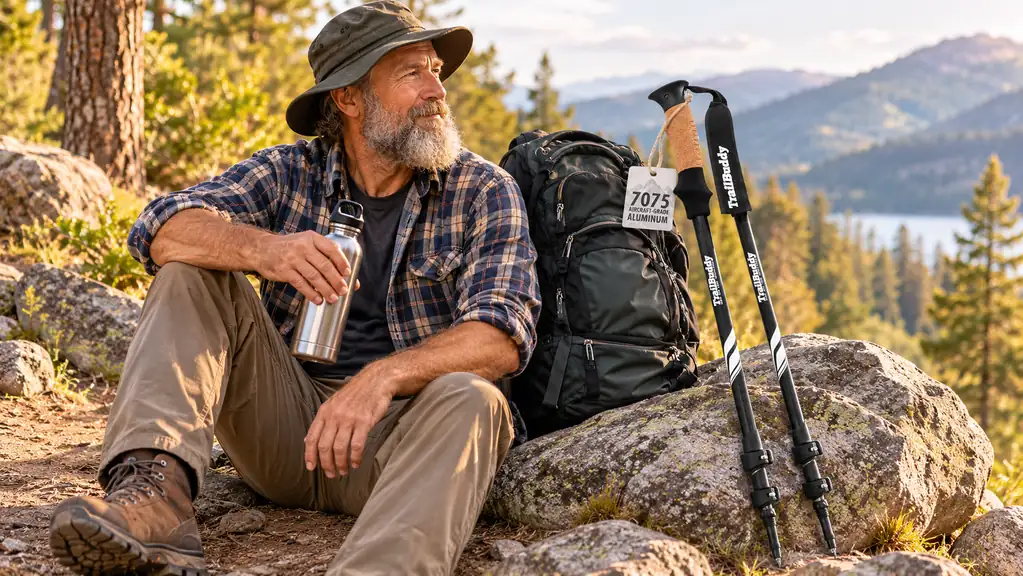
Two 7075 aluminum poles, lever locks you can flip with one hand, and a five year limited warranty. This is what I walk with.
Amazon Check Today's Price on Amazon →They take a share of the load off every step downhill
A pole planted in front of you catches weight your knee would otherwise absorb. Do it with both poles and you are spreading the force of a descent across four contact points instead of two. On a long downhill I can feel the difference in the first hundred yards, not the last mile. That early relief is what keeps the whole day possible.
They slow the descent without you having to think about it
The reason downhills hurt is partly speed. Gravity pulls, your foot lands hard, and the impact travels up through the shin to the knee. A pole gives you something to reach for, so your natural rhythm settles into something more deliberate. I do not have to remind myself to go easy. The poles do the reminding.
They give your bad leg a partner on the steep stuff
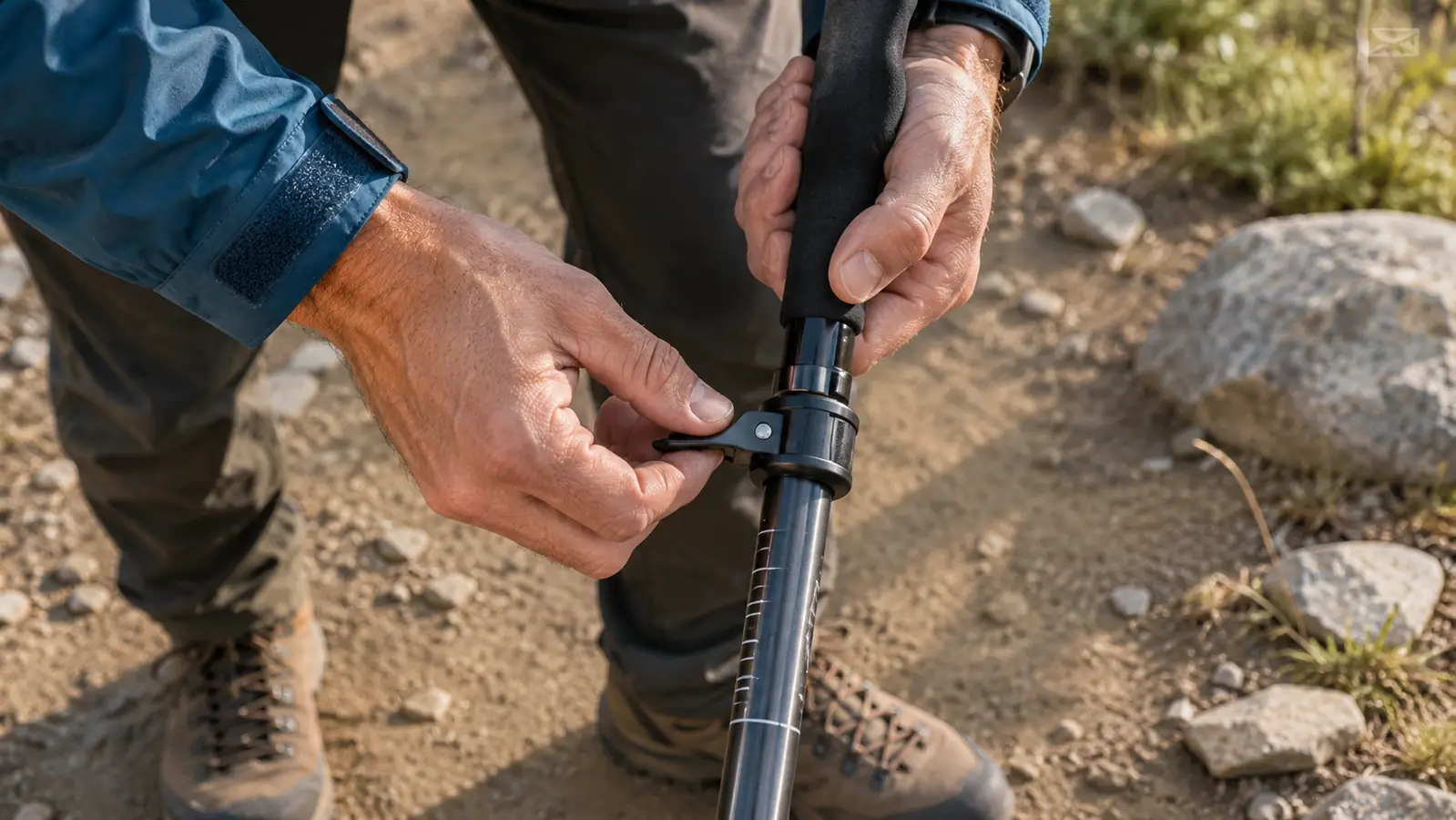
My left knee is the weak one, so I plant the right pole a beat earlier on a steep step down and let my right arm carry a little more. Small adjustments like that are invisible to anyone hiking behind you. They matter on a 10 mile day. TrailBuddy's poles set to height in seconds with the lever locks, so I can drop them a touch for a long descent and put them back up at the bottom.
They keep you balanced when the trail turns to gravel
Red Rock has stretches of loose scree that roll underfoot. Twisting an ankle is the obvious risk, but the quieter problem is the little correction your knee makes every time a foot slips. Poles take those corrections for you. Ray noticed it before I did, on the talus section below the Calico Tanks turnoff. He said I stopped doing that little hop.
They save your knee on the climb too, just differently
Uphill is a quad and glute job, so the knee gets less of the abuse and more of the repetition. Poles let your arms share the push, which means fewer hard efforts per step and a slower build of fatigue. The benefit is indirect but real. Tired legs get sloppy on the way down, and sloppy is where knees get hurt.
They are light enough that carrying them costs nothing
Each pole weighs 9.7 ounces. That is less than a full water bottle, and I notice the difference at the end of a long day when my arms are already tired. I have carried heavier poles on a borrowed pair and by mile eight I was dragging them. Light gear gets used. Heavy gear gets strapped to the pack.
One-handed lever locks mean adjusting mid-trail is not a chore
The old twist locks on my first pair needed two hands and a firm grip, which is awkward when you are standing on a slope. The lever locks on the TrailBuddy poles flip open and shut with one hand. I adjust them while walking now, which sounds like a small thing until you have needed a height change on a switchback and skipped it because it was too much bother.
They collapse small enough to live in the car
Fully collapsed they come down to 24.5 inches, from a 54 inch maximum. That means they fit in the back of the Outback next to the daypacks instead of rattling around loose. Mine have been in that car since March. Gear you always have with you beats gear you remember to pack, and my knee does not care whether I planned ahead.
They handle the awkward stream crossings
There is a spot on the Mount Charleston trail where you either hop two rocks or get your boots wet. A pole planted in the streambed gives you a third point of contact, which takes the guesswork out of it. My knee dislikes hopping. It dislikes a twisting landing even more. One pole in the water solves both problems.
They make the day after a hike normal again
This is the honest one. The measure I actually care about is whether I can walk down the stairs on Sunday morning without holding the rail. With poles on Saturday, I usually can. Without them, I am reminded of it for two days. That is the whole case for carrying them, and it is a better argument than anything a spec sheet can make.
The measure I actually care about is whether I can walk down the stairs on Sunday morning without holding the rail. With poles on Saturday, I usually can.
What I'd Skip
I would skip the wrist straps if you are new to this. A lot of hikers loop them tight and then lean on them, which is hard on the wrist and does not help the knee. Set them loose or leave them off until you have a rhythm. I would also skip carbon fiber if you hike the way I do. Carbon is lighter, and it is wonderful right up until it cracks on a rock, and then it is done. 7075 aluminum bends and keeps going. I have leaned hard on mine on a bad step and they are still straight.
And I would skip buying two poles if you have never used one. Borrow a single pole, or use one of your pair for a couple of hikes, and see whether you actually like the reach. Some people hate the feeling of their arms doing work. I did, for the first hour. Then I did not. If you want the fuller comparison, my long term notes and the cork grip comparison cover the details.
Two poles, one sore knee, and a Sunday with no rail
7075 aluminum, one-handed lever locks, and a five year limited warranty. Mine live in the car. They have earned the space.
Amazon Check Today's Price on Amazon →