
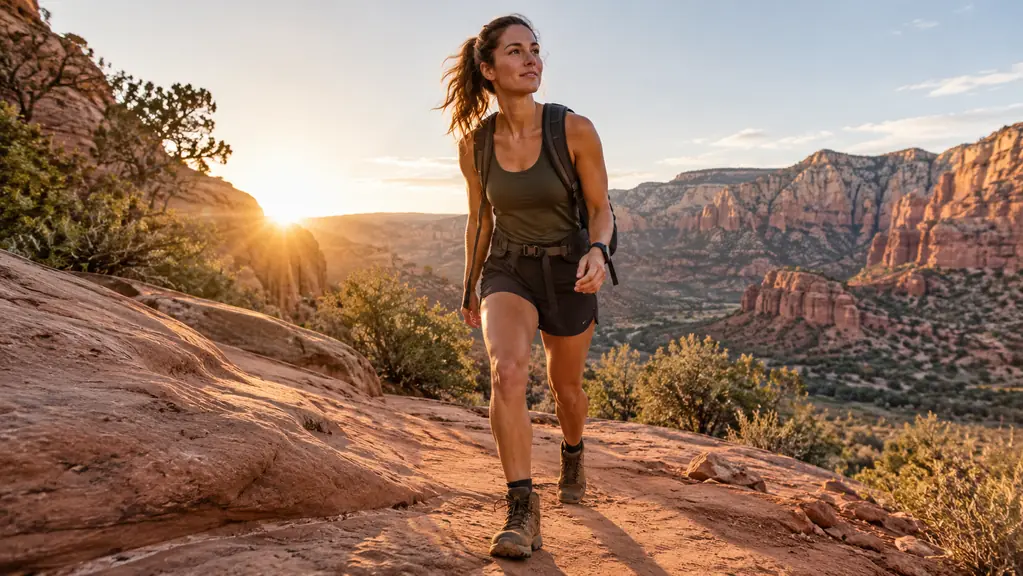
Ray and I did not set out to test trekking poles. We set out to keep hiking. My left knee had been complaining on descents since spring, and by June I was choosing trails by how little downhill they involved instead of how much I wanted to see them. That is a sorry way to plan a Saturday.
So I bought a pair of TrailBuddy Trekking Poles in March and used them for the whole season. Not a couple of weekends. From March through October, roughly forty day hikes at Red Rock Canyon and up on Mount Charleston, plus a week in Zion and Bryce in September and a long weekend at the Grand Canyon after that. One pair. No backup set in the car. Ray bought his own in April, and between us we put a lot of miles on them.
The Quick Verdict
The lever locks are the reason to buy these. I can open and close them one-handed with a glove on, which is more than I could say for the twist-lock poles I borrowed last year. At 9.7 ounces per pole they are light enough to forget on the side of a daypack, and after a full season of 4 to 8 mile days the locks still close with the same firm snap.
Amazon Check Today's Price →The lock I could tighten with a glove on
TrailBuddy poles set anywhere from 24.5 inches collapsed up to 54 inches, with lever locks instead of twist locks. Mine have been on roughly forty day hikes and they still hold.
Amazon Check Today's Price on Amazon →How I've Used It
Here is the honest shape of my hiking. I am 58, retired from a school office, and I live in Henderson, which means Red Rock Canyon is twenty minutes from my driveway. Ray and I go twice a week when the weather cooperates, usually four to six miles, sometimes eight if the morning is cool and neither of us is in a hurry. In summer we move up to Mount Charleston, where the trail starts in pine and stays there.
I am not a backpacker. I do not carry a tent, I do not sleep on the ground, and I do not pretend a four mile loop with a daypack makes me a thru-hiker. What I needed was something that would take weight off my left knee on the way down and give me a third and fourth point of contact on the loose stuff. That is the whole job description, and it is the standard the rest of this review is measured against.
The poles live in the back of the silver Outback. They have been to Zion twice, Bryce once, and the Grand Canyon once, and they have been rained on exactly one time, which for southern Nevada is a story in itself. In between they get used on the same handful of trails over and over. That is probably a better test than one big trip, because there is no novelty to distract you from what is annoying.
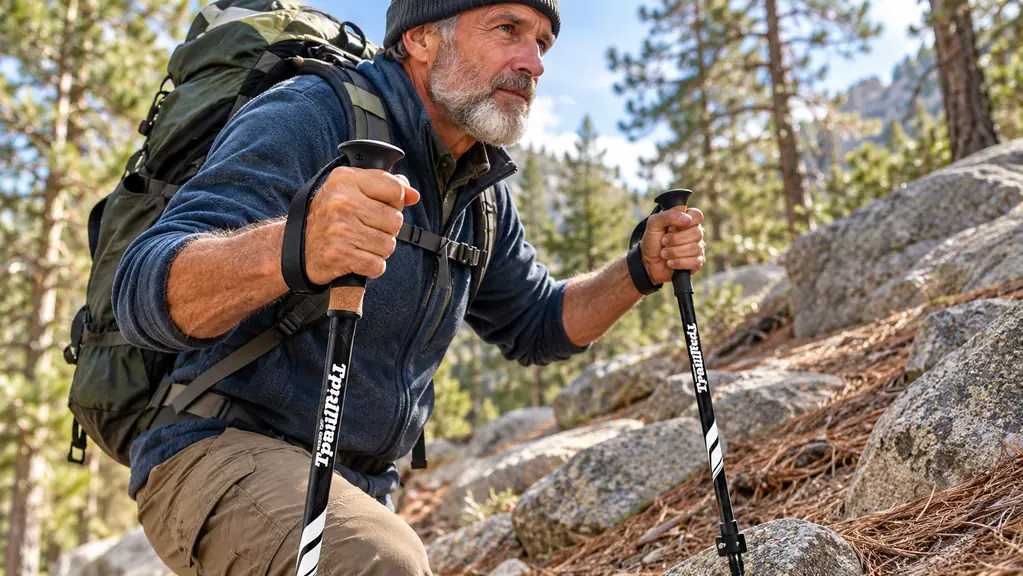
What 9.7 Ounces per Pole Actually Feels Like
TrailBuddy lists each pole at 9.7 ounces, with the full set at 1.2 pounds. On paper the number does not mean much. On your back it does. The first thing I noticed was that I stopped noticing them. They strap to the side of a daypack and stay there, and on the days I carried them collapsed instead of using them, I never once felt like I was hauling extra weight up a climb.
The shafts are 7075 aluminum, which is the same family of alloy used in a lot of bike frames and aircraft parts. I cannot test tensile strength in my driveway. What I can tell you is that I have planted them hard on rock, wedged one into a crack to step down, and put most of my weight on a single pole while crossing a sandy wash, and neither one bent or developed a wobble. There is a slight flex if you really lean on them, and I consider that a good sign rather than a bad one. Poles that do not give at all are the ones that snap.
Collapsed, they come down to 24.5 inches. For a day hiker that number matters more than the top end. A 24.5 inch bundle fits along the side of my pack or under the lid, and it fits in the back of the Outback without me rearranging anything. At full extension they reach 54 inches, which leaves plenty of adjustment left at both ends for me and for Ray. The listing calls it a standard size that fits all heights, and from how much pole is left over in either direction, that claim holds up.
I weighed them on the kitchen scale the week they arrived, mostly out of suspicion. The scale said 9.7 ounces for the pole I set on it, and a shade under 1.2 pounds for the pair with the straps attached. I wrote both numbers on the back of a receipt and left it on the counter for a month, which tells you how I am about these things. What it translates to on a trail is simpler than a number: when I hand a pole to Ray at a trailhead so I can retie a bootlace, it does not feel like I am holding a fence post. The borrowed pair I used last spring did.
The Lever Locks Are the Whole Story
Every trekking pole problem I have ever had came down to the lock. The twist-lock pair I borrowed last spring took two hands, a firm grip, and a certain amount of muttering to set. If I wanted to shorten them for a steep section, I had to stop, sometimes take my pack off, and wrestle. With gloves on in cold weather it was worse.
The TrailBuddy poles use a lever lock. You flip it open, slide the section to where you want it, and flip it closed. One hand. Glove on. I do it while walking, usually without breaking stride, and it takes about two seconds. Written out on a page that sounds like a small thing. On a trail that switches between open rock and steep shaded steps, it is the difference between adjusting your poles and just living with the wrong length for the next mile.
A cold morning on Mount Charleston in late October is where I stopped taking it for granted. It was 34 degrees at the trailhead and I had liner gloves on. I set both poles long for the climb, hiked a mile, then shortened them by about four inches for a stretch of rock steps. I did it while walking, one pole at a time, and I never took a glove off. The borrowed twist-lock pair from last year would have cost me a full stop and a minute of fiddling in the cold. That minute, repeated four or five times a hike, is the reason I stopped using them.
The other detail I did not expect to care about is the threaded tips. The baskets screw on rather than press on, so they stay on. I lost a basket off a borrowed pole in mud once and did not notice until it was gone. These have stayed put through sand, through that one rainstorm, and through a snow patch on Charleston in late October. The set arrives with mud baskets, snow baskets, a carry bag, and spare tips, and the spares live in the bag in the car.
Forty-some hikes on one pair of poles, and the locks still close with the same firm snap they had in March.
My Left Knee, on the Downhills, All Season
This is the part I actually bought them for. My left knee hurts on descents. Not a sharp pain, more of a dull grinding complaint that starts around mile three of anything steep and stays with me through the evening. It is why I had quietly stopped doing the Red Rock trails with long rocky downhills, and I missed them.
The first Saturday in April is the one I remember. We did Calico Tanks at Red Rock, a little under three miles out with a rocky, stepped descent that used to leave me quiet in the car on the way home. I used the poles the whole way down, planting each one ahead of me and letting my arms take a share of the load. That evening my knee felt like it had done a two mile walk instead of a five mile one. It is not a scientific measure. It is the measure I actually have, and it was the first time in a year that a descent did not cost me the rest of the day.
I will not tell you the poles fixed anything. The knee still complains. But some of my weight goes into my arms and shoulders instead of straight through the joint, and on an eight mile day with a long descent I finish the way I used to finish a five mile day. The place it mattered most was the Grand Canyon, a couple of miles down the South Kaibab and back up. Everyone tells you the way down is the easy part. Everyone is wrong. The poles were the only reason I enjoyed the second half of that morning instead of just managing it. Ray uses his differently, planting both together on steep steps, and says it takes the jar out of his right hip.
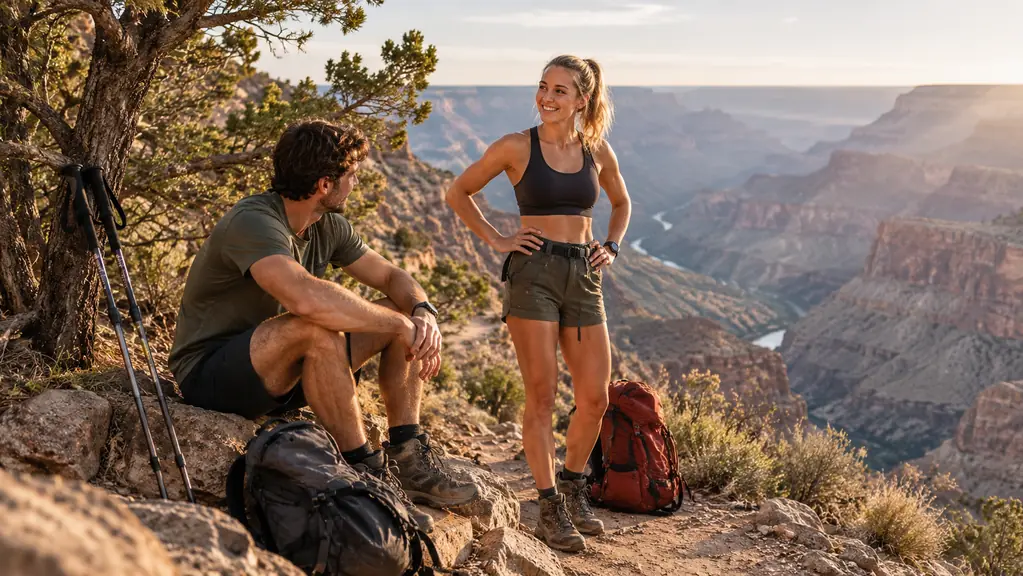
What Held Up, and What Bothered Me
After a season with the TrailBuddy poles, here is the honest list. The locks have not slipped. Not once, on any trail. The padded straps are comfortable against bare hands and do not cut in on long climbs. The grips themselves are where I have a real complaint: on a hot climb in July my hands got sweaty and the grip got slick under my palm, and I found myself readjusting my hold on the steeper sections at Charleston. It is not a deal breaker and most people will not notice, but I did.
The other small thing is the collapsed length. 24.5 inches is compact for an aluminum pole, but a dedicated folding pole packs smaller. If you are trying to fit poles inside a small daypack rather than strapped to the outside, that is worth knowing before you buy. For me it has never been an issue, because mine ride on the outside of the pack and always have.
Tip wear is the one thing that has visibly changed. The tips that came on the poles have lost maybe an eighth of an inch over the season, judging by how much shorter they look next to the spares in the bag. That is normal and expected on the sandstone around Red Rock, which eats rubber and metal both. I swapped to the spares in early October, not because the originals had failed but because I had the Grand Canyon coming and did not want to think about it on the way down. The swap took about thirty seconds a pole, and the threads took the new tips without any fuss.
There is also a five year limited warranty covering defects, which I have not had to use. That is the sort of thing you only learn about when something goes wrong. Its existence is a point in their favor, not proof of anything, so I am mentioning it and moving on.
What I Liked
- Lever locks work one-handed, with gloves on, in about two seconds
- 9.7 ounces per pole, so they disappear on the side of a daypack
- Threaded tips keep baskets attached through mud, sand, and snow
- Collapses to 24.5 inches and extends to 54, enough range for two different hikers
- No lock slip and no wobble after roughly forty day hikes
- Five year limited warranty, carry bag, and spare tips included
Where It Falls Short
- Grips got slick under sweaty hands on a hot climb
- 24.5 inches collapsed is good for a daypack but not as small as a folding pole
- You still have to glance down now and then and confirm a lever is fully closed
Who This Is For
Day hikers who want one less thing to fight with. If you walk 4 to 10 mile trails with real climbing and descending, and your knees or hips have started sending messages, these are a sensible first pair or a sensible replacement pair. They suit someone who wants to set the length at the trailhead and change it once or twice mid-hike without stopping. They also suit a household where two people of different heights share a set, because the adjustment range is wide and the locks swap over in seconds.
If you are buying your first poles and are not certain you will use them, this is a reasonable place to start, precisely because nothing about them requires technique. You plant, you push, you go. There is no learning curve and no maintenance routine beyond a glance at the levers.
Who Should Skip It
If you backpack overnight and count ounces, look at a folding pole with a smaller packed size. 24.5 inches is good on a daypack and less good inside a loaded pack. If your hands sweat heavily and you hike in serious heat, a cork grip will treat you better, and it is worth reading a cork grip comparison before you decide, because that is a genuine tradeoff rather than a marketing difference.
And if you want poles you never think about at all, understand that you will still think about these a little. Not because they fail, but because any lever lock rewards a quick glance to confirm it is fully closed. That is a small habit, not a flaw, and it has been true of every pole I have used. What I can say after a full season is that the glance always confirmed the same thing, which is the outcome you want.
One season, forty hikes, no lock slip
Lever locks you can work with gloves on, 9.7 ounces per pole, and a collapsed length that fits beside a daypack. Mine have been to Red Rock, Zion, Bryce, and the Grand Canyon and they are still going.
Amazon Check Today's Price on Amazon →