
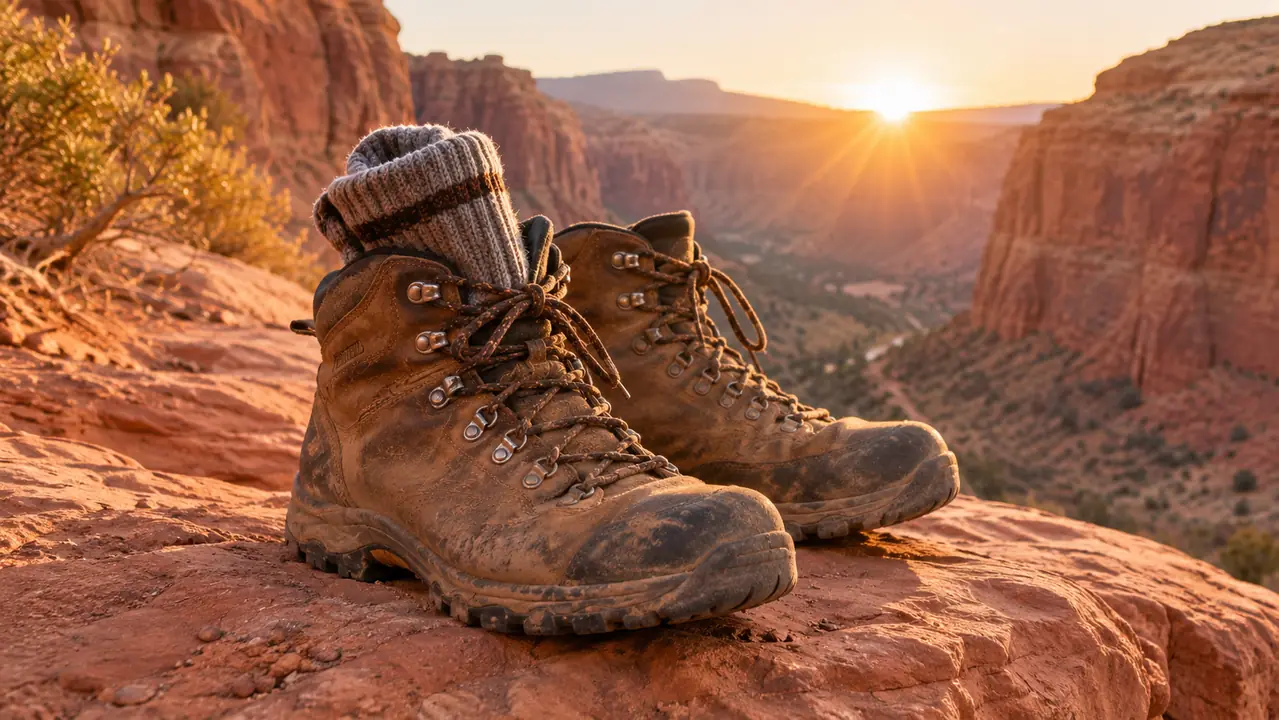
I bought the first pair for Ray, not for me. He is 61, he has a wide foot, and for two hiking seasons he had been telling me his boots were fine until about mile six, at which point something under his arch started to rub. New boots are an expensive guess. Socks are a cheaper one. So I ordered a pair of Darn Tough Hiker Midweight Micro Crew socks and handed them over without expecting much.
That was three years ago. We now own six pairs between us. I wear the men's cut in the smallest size, which is the version we bought and the one that fits me, and Ray wears his usual size. My short answer on whether these are worth it is yes, with two conditions that appear nowhere on the listing: you have to get the size right the first time, and you have to stop expecting a sock to feel like a slipper.
What follows is everything I would tell a friend in the trailhead parking lot, including the parts that are not flattering.
The Quick Verdict
The sock we both reach for on every 4 to 10 mile day hike. Snug by design, honest about its limits, and unforgiving if you order the wrong size.
Amazon Check Today's Price →The pair Ray stopped taping his heels for
A merino blend micro crew that stays put on long downhills. Check the size chart before you order, because this fit is not forgiving.
Amazon Check Today's Price on Amazon →How These Socks Got Into Our Rotation
Most of our hiking is close to home. We live in Henderson, so Red Rock Canyon is twenty minutes away and Mount Charleston is a little further but ten to fifteen degrees cooler in July. Those are 5 to 8 mile days on sandstone and dust. Twice a year we load the Outback and drive north or east, to Zion, Bryce, or the Grand Canyon, and those are the days that run longer and end with the kind of steady downhill that makes my left knee file a complaint.
The socks have handled all of it without a single blister, which is the sentence I care most about. Ray is the blister-prone one in this household. He used to carry a small roll of tape and wrap his heels in the parking lot as a precaution. He stopped doing that after the second trip in these.
The quieter change was laundry. We used to bring four or five random pairs each on a road trip and still run out. Now we bring three pairs apiece, hand-wash one pair in the motel sink at night, and the rotation holds for a week. In a bathroom in Springdale with no dryer in sight, that is not a small thing.
The Fit Is the Whole Review
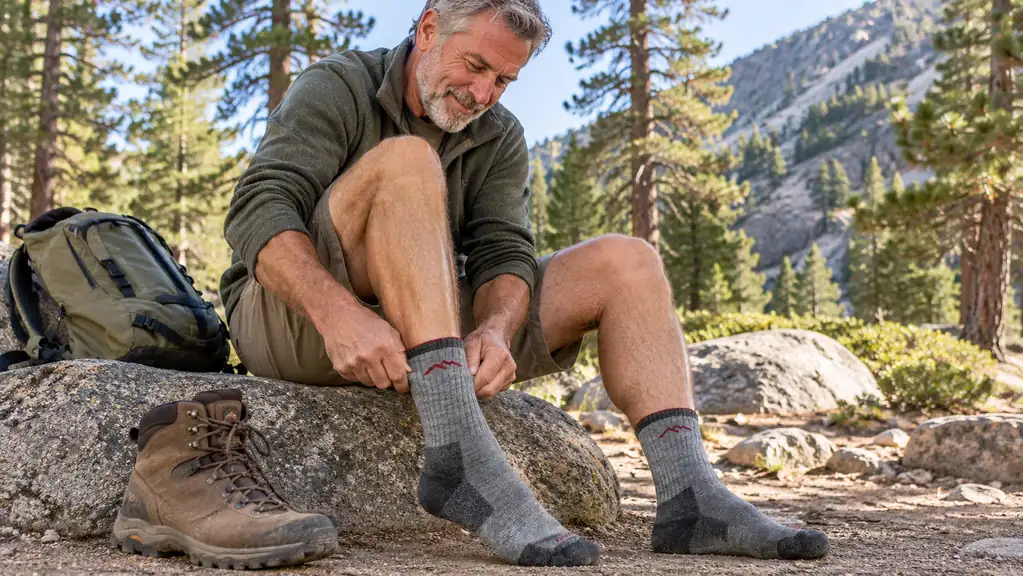
If you take one thing from this, take the sizing. These run snug on purpose. Out of the package they feel a notch tighter than the athletic socks in your drawer, and the first time you pull one on you will wonder whether you ordered wrong. You probably did not. The wool relaxes slightly with wear and the sock settles into the shape of your foot.
But the sizes themselves are honest. Ray is a 10.5 in most shoes and wears a Large. I wear the smallest men's size and it fits, though there is a little extra room in the toe for me. If you are between sizes, or you have a wide foot or a high instep, go up. A sock that is too small will feel tight across the top of your foot by mile four, and no amount of breaking in fixes that.
The micro crew height is worth understanding before you buy. It sits just above the collar of most hiking boots, which is why it works in heat and why it disappears under pants. It is not tall coverage. If you wear low-cut trail shoes and want the sock to cover your ankle bone, this is not that sock.
The upper is ribbed and stays where you put it. I have never once had to stop and haul these back over my heel, and I have owned socks where that was the entire hike. There is also no lumpy seam across the top of the toes, which sounds like a small courtesy until you spend a full day in a sock that has one.
What the Wool Blend Actually Does
The material is 61 percent merino wool, 36 percent nylon, and 3 percent Lycra spandex. That ratio matters more than the word wool on the label. Pure wool would be soft and would also grind through at the heel inside a season. The nylon is what keeps them from falling apart, and the spandex is why they stay put.
The listing calls them midweight and a fabric weight field on the same page says lightweight. Both are a little true. They are thicker than a dress sock and thinner than a heavy cushioned winter sock. Underfoot there is enough padding to take the edge off sharp rock and not enough to make a broken-in boot feel tight. If you already like the fit of your boots, this is about the right amount of sock to put inside them.
The itch question comes up whenever I mention wool socks, so here it is. These do not itch me, and I am the person who could not wear a wool sweater through the nineties. Merino is a different animal from the scratchy stuff, and after ten minutes on your foot the difference stops being noticeable at all.
Merino does the temperature thing people talk about, and in our heat it is real. Red Rock in June runs well over a hundred degrees on the sandstone. My feet sweat in these, because feet sweat, but the sock does not turn into a wet rag and it does not smell like a gym bag at the end of the day. Ray wore one pair for three hiking days in a row on our last trip and I could not tell you which day was which by smell. I could not write that sentence about cotton.
Machine wash is on the care instructions and that is how we clean them, cold, and we do not put them in the dryer. They have held their shape. I know people who tumble theirs and I know people who blame that when a wool sock dies young. I am not going to run the experiment.
Three Years of Wear, Pair by Pair
The oldest pair is three years old and has a thin patch at the heel. No hole, no thin spot at the ball of the foot, and the elastic at the top still holds. For a sock that gets worn once or twice a week in season and washed just as often, that is better than anything else in my drawer.
The pair I wore through the Zion and Bryce trip took the worst of it, three days of downhill with a pack that had no business being that heavy on a day hike. The heel is slightly fuzzy. The toe is intact. The cuff has not gone slack, which is the failure I expect from cheaper wool socks and the reason I stopped buying them.
The only real wear signal is the padding under the ball of the foot, which flattens a little after a couple of seasons. You feel more of the trail through them at that point. It is not a hole and it is not a reason to stop wearing them, but it is where the clock starts. One pair also lives permanently in the Outback's door pocket as the spare, and it has been pressed into service on a cold morning at Mount Charleston more than once.
What I Compared Them To Before Settling
Before these, our default was a plain cotton crew sock, which is what most people hike in and what most people get blisters in. Cotton holds water against your skin and stops insulating the moment it is damp. The difference on a hot, dusty Red Rock loop is not subtle. It is the difference between feet that feel fine at the truck and feet that need the windows down and the shoes off.
I also tried a thin merino liner under a cushioned synthetic crew. That combination works, and it is fussier. Two layers means two things to wash, two things to lose, and one more place for grit to collect. The Darn Tough pair does the job of both without the extra layer, and on a 6 mile day I cannot tell the difference in comfort.
A heavier cushioned wool sock felt better in camp and worse in the boot. It pushed my heel back in the shoe and turned a good fit into a mediocre one. This is the trade I keep coming back to: this sock is not the softest one I own, it is the one that lets my boots do what they were fitted to do.

The Parts That Bugged Me
An honest review has to say the annoying parts out loud.
First, they are not plush. If you are coming from a thick cushioned sock and expecting that pillow feeling, you will be disappointed. These cradle the foot rather than pad it, and on a long descent over sharp rock at Bryce I could feel the ground more than I wanted to.
Second, they hold water. We crossed a creek on the Grand Canyon trip and my feet stayed damp maybe an hour longer than they would have in a synthetic sock. Wool keeps you warm when wet, which is the whole point of wool, but it does not dry fast. On a warm day hike that is a shrug. On a cold morning it matters.
Third, the instep. Ray has a high arch and his first pair felt tight across the top of his foot until it loosened up. He buys one size up now and has no complaint. That is a fit note rather than a defect, but it is the kind of thing you only learn after a bad day.
Fourth, the cost. I am not going to quote a number, but this is not a sock you buy five of on a whim. The math only works if you actually hike. If you get out three or four times a year, a multipack from the sporting goods store will do everything you need and you should keep your money.
Ray wore one pair for three hiking days in a row and I could not tell you which day was which by smell. I could not write that sentence about cotton.
What I Liked
- Three years of day hikes with no blisters, including a wet week in Zion and Bryce
- Merino blend of 61 percent merino, 36 percent nylon and 3 percent Lycra resists odor across back to back days
- Micro crew height clears most boot collars without adding bulk
- Ribbed upper stays up, so no mid-trail tugging
- Machine washable and holds its shape with a cold wash and air dry
- Lifetime guarantee stands behind the purchase
Where It Falls Short
- Snug fit is unforgiving if you order the wrong size
- Not plush, with less underfoot protection on sharp rock than a heavy cushioned sock
- Dries slower than a synthetic sock after a creek crossing
- Tight across the instep for a high arch until broken in
- The guarantee means mailing the socks in and waiting
The Guarantee, and What It Actually Takes
Darn Tough backs these with a lifetime guarantee, and that is the reason a lot of people give them a try in the first place. The part that gets left out of the same breath is the process. You pack the socks up, you mail them in, and you wait. You are not walking into a store and swapping them across the counter.
My oldest pair has the thin heel patch after three years and I still have not sent it in, because the pair works and I would rather keep hiking in it than be without it for a few weeks. That probably tells you as much about the guarantee as it does about the socks. It is a real safety net and it is slower than just buying another pair, which is the honest trade.
Who This Is For
This sock is for the hiker who does regular day hikes in the 4 to 10 mile range and wants one less thing to think about. It is for the person whose boots are broken in and whose feet are the last unsolved problem. It is for anyone who has ever taped a heel in the parking lot as a precaution.
It is also, quietly, for the person with a sore knee who knows socks will not fix that. On a long downhill a sock that does not slide is one less thing shifting around inside a boot. I am that person. The Darn Tough Hiker did not fix my knee. It made the descent less of a negotiation.
Who Should Skip It
Skip them if you hike a handful of times a year. Skip them if what you want is a thick, soft, cushioned sock for camp and cold weather. Skip them if you have a very wide, very high-volume foot and you are not willing to size up or send back a pair that does not work.
And skip them if you are not going to look at the size chart. The most common way these socks fail people is the wrong size, and that is a wound you inflict on yourself. Order two sizes if you are unsure, try both on the carpet, and send one back.
Fix the feet first, then worry about the boots
Three years of desert and canyon miles, and the only complaint is a thin heel patch. Check the chart and order the size you actually need.
Amazon Check Today's Price on Amazon →