

The first time I pulled on a pair of Darn Tough Vermont Hiker socks, I did what I always do with a new piece of gear. I looked at them, decided they were too thick, and put them in the drawer for three weeks. I am 58, I have a left knee that complains on every long downhill, and I spent most of my hiking life in whatever cotton crew socks happened to be clean that morning. I did not believe a sock was going to change a hike.
Two years later, the Darn Tough Hiker Midweight Micro Crew is the only sock I reach for. Ray wears the same sock. We buy them in the men's cut, and I wear the smallest men's size, because that is what the sizing note on the package tells you to do. In the middle of a Nevada summer, on a trail where the rock is already radiating heat at nine in the morning, these are what we pack. That is not a small thing, and it took me a while to get there, so here is the honest version.
The Quick Verdict
The best day-hiking sock I have owned, and the only one I have not worn a hole through. Midweight is warm for a desert July, and the micro crew height sits right at the boot collar, which took me a month to stop noticing.
Amazon Check Today's Price →The sock I stopped thinking about two years ago
Midweight merino, reinforced heel and toe, micro crew height. If your hiking socks are the last thing you think about before a trail day, this is the fix.
Amazon Check Today's Price on Amazon →How I've Used It
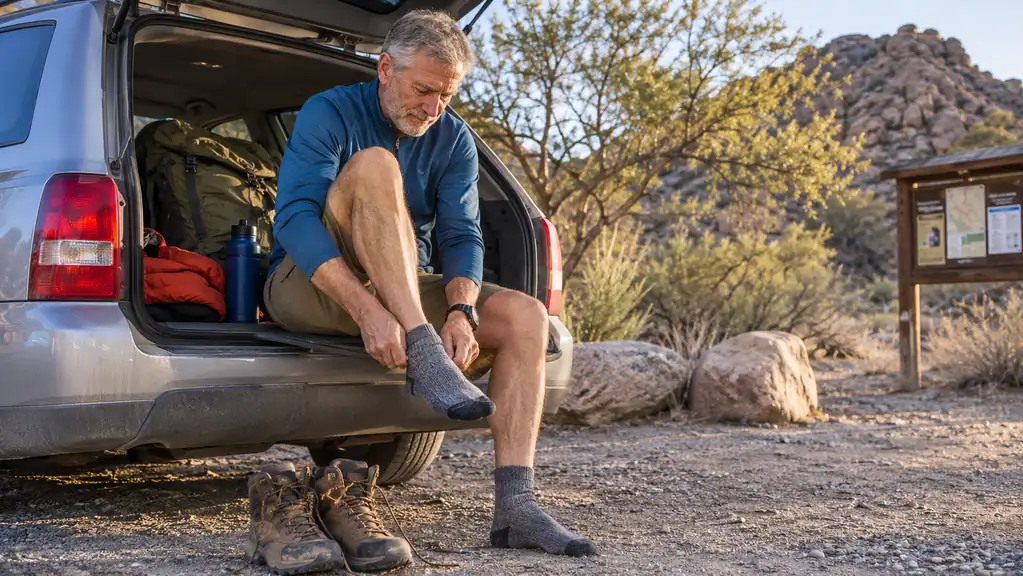
We live in Henderson, so most of our hiking is Red Rock Canyon, which means sandstone, exposed rock, and a lot of short steep sections that punish your feet on the way down. On weekends we drive up to Mount Charleston when we want cooler air and a longer climb. Once or twice a year we take the silver Subaru Outback on a road trip, and those are the big-mile days: the Grand Canyon rim, Zion, Bryce.
My normal hike is four to ten miles. I do not backpack overnight. So this is not a review from someone who has put two thousand miles on a long trail. It is a review from someone who has put the same two pairs of socks through roughly two years of desert day hikes, a great deal of laundry, and one very memorable fourteen-mile day at the Grand Canyon that I did not train properly for.
I keep two pairs in rotation and a third in the laundry basket. The pair I think of as the first one has been on somewhere around sixty day hikes now. It went up the Ice Box Canyon route at Red Rock in February, when the shade still had frost in it, and it came back down the same trail in June when the rock was too hot to rest a hand on. It went to Zion in April of last year. It walked the Rim Trail at the Grand Canyon in October, which is where it earned its keep.
That Grand Canyon day is the reason I am writing this. My knee was sore by mile eight, my feet were not. That had never happened before. I had always assumed foot fatigue on a long descent was just part of hiking. It turns out that most of it was my socks.
Before these, I tried a thin synthetic liner sock under a cotton crew. That combination is popular advice and it did not work for me. The liner slid, the cotton outer got damp and stayed damp, and by mile six the two layers had bunched into a wad under my arch. I also tried a cushioned wool-blend sock from a department store, which felt wonderful for about three hikes and then went thin at the heel. Neither of those is a knock on liner socks in general. It is a knock on my patience.
What Is Actually In Them
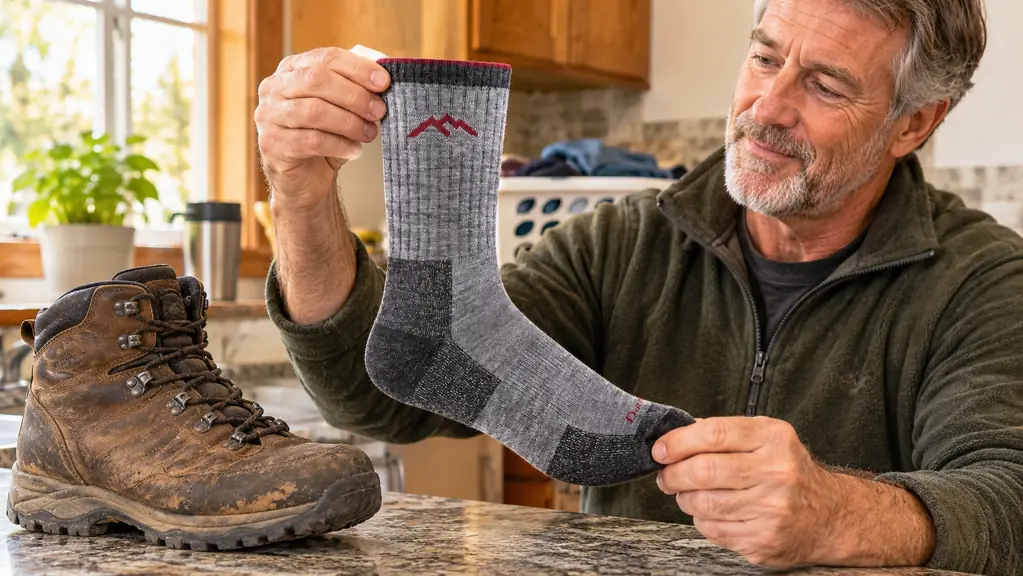
The Darn Tough Hiker is a merino wool blend: 61 percent merino, 36 percent nylon, 3 percent Lycra spandex. The listing also shows a fabric breakdown of 63 percent merino, 35 percent nylon, 2 percent Lycra, so the exact ratio depends on which line on the tag you read. Either way, the story is the same. Merino does the moisture work, nylon does the durability work, and the spandex keeps the sock from sagging down into your boot after a few hours.
That last part sounds trivial and is not. My old cotton socks would stretch out by mile three and start bunching under my arch. That bunching is what makes a hot spot, and a hot spot is what becomes a blister. A sock that stays where you put it removes an entire category of foot problem before it starts.
The listed weight is 3.2 ounces. It is machine washable, which I know because I have machine washed these things for two years and they have not fallen apart. The care tag says machine wash and that is what I do, warm water, regular detergent, and then I air dry them on a rack out of habit rather than necessity.
They are made in the USA, in Vermont, and that is on the packaging. I mention it for one reason only, which is that the guarantee is tied to a company still making the thing it guarantees. Plenty of brands will warranty a product they stopped producing five years ago. That is not the same promise.
Darn Tough calls this a lightweight fabric weight class in the attributes, but it is sold as a midweight, and midweight is the honest description. There is real cushioning under the ball of the foot and the heel. This is not a thin liner sock, and if you are used to a liner, the first pair will feel like a lot of sock.
How They Held Up Over Two Years
This is the part that matters, because anyone can review a sock on day one. Here is what two years of desert hiking actually did to them.
The heel and toe are reinforced, and that reinforcement is where my old socks always failed first. On a cotton crew sock, the heel wears through in a season, and once it goes you have a hole and a blister in the same spot. On these, two years in, the heel shows a slight thinning in the knit and no hole. The toe has held almost perfectly. The elastic at the cuff is still tight enough that the sock does not slide down inside the boot.
I wash hiking socks after every single hike, which means these have been through the machine something like two hundred times between the two pairs. That is not an exaggeration. There is a small basket by the washer and it fills up fast in hiking season, which for us runs October through May, with a few early morning summer walks mixed in when the heat backs off enough to be reasonable.
Once a season I turn them inside out and look at three places: the heel, the toe, and the seam across the top of the foot. The seam is where a cheap sock rubs you raw. On these, the seam is flat and has stayed flat. The inside of the heel is where the knit takes the most abuse, and on my oldest pair it has gone slightly fuzzy rather than thin.
The merino has, if anything, gotten softer. Darn Tough socks feel a little stiff and scratchy right out of the package. That lasted about four or five washes. Now they feel like the socks I have owned for a decade, which is exactly what you want from a wool sock.
The solid pattern has faded a little across the top of the foot. I do not care, and neither will you after your first muddy trail day.
One pair did develop a small hole at the outside edge of the heel at about the eighteen-month mark. I sent them in under the Darn Tough lifetime guarantee, which requires you to mail the socks back, and they replaced them. The whole thing took a few weeks and cost me a padded envelope. I am not going to pretend that process was instant, because it was not. But it worked, and I have never had another sock brand do that for me.
My knee was sore by mile eight at the Grand Canyon. My feet were not. I had always assumed foot fatigue on a long descent was just part of hiking.
The other thing I noticed, and this surprised me, is the smell. Merino wool does not hold odor the way cotton does. On a road trip where we hiked three days in a row and I only packed two pairs, that mattered. Rinse them in a sink, hang them overnight, and they are fine in the morning. Cotton socks in that scenario become something you do not want in the car with you.
The Micro Crew Height, and Why It Matters
Micro crew sits just above the boot collar. Not a full crew that comes up your calf, not an ankle sock that leaves a gap between the sock and the boot. For day hiking in boots, that gap is where grit gets in and where the boot collar rubs.
I will be honest: the first month, I thought the height was odd. I was used to a taller sock. Then I stopped noticing, which is the highest compliment I can give a piece of gear. There is no seam pressure point at the top of the boot, and no sand working its way down. On the Red Rock trails, where there is sand in everything, that is worth more than it sounds.
If you wear low-cut trail runners rather than boots, this height is more sock than you need and the extra fabric will feel like overkill. If you wear mid or full hiking boots, it is right.
Where the Darn Tough Hiker Falls Short
Midweight is warm. In Henderson in July, when the trailhead is already in the nineties at seven in the morning, these socks are too much. I wear them anyway on short hikes, but I have learned to bring a lighter pair for the hottest months. Anyone hiking in real desert heat in midsummer should know that going in. This is a three-season sock for most people, and a four-season sock only if your summers are mild.
Sizing is the other frustration. The men's cut is the only one listed, and the jump between the small and the medium is bigger than it should be. I wear the smallest men's size and it fits, but it fits because my feet run wide. A woman with a narrower foot in that same size range may find the heel sits a little low. Order one size and hike a short trail in them before you commit to a long one.
There is also the matter of drying time. A midweight merino sock does not dry as fast as a thin synthetic one. If you rinse a pair in a hotel sink and hang it, it will still be damp at the heel by morning in a humid place. In Nevada that is a non-issue. On a road trip through a wet spring in Utah it was mildly annoying, and I ended up hanging them over the seat back with the window cracked.
Ray's complaint is different and worth passing along. He is 61 and his feet run hot, and he finds the cushioning under the ball of the foot a little much in summer. He wears them anyway from November through April and switches to something thinner in the warm months. Two people, same sock, same size, two different opinions. That is probably the most useful thing I can tell you.
And yes, they cost more than the socks most people buy. I am not going to quote a number because prices move, but check today's price and compare it against what you spend replacing cheap socks every spring. For me the math went the other direction after the first year.
What I Liked
- Merino blend keeps feet dry and does not hold odor the way cotton does
- Reinforced heel and toe, which is exactly where my old socks failed first
- Micro crew height clears the boot collar with no gap for grit to get in
- Machine washable and still intact after roughly two hundred washes
- Cuff elastic still tight after two years of regular use
- The lifetime guarantee is real and I have used it once
Where It Falls Short
- Midweight runs warm once the trailhead is in the nineties
- Takes four or five washes to soften out of the package
- The gap between the small and medium men's sizes is real
- Dries slower than a thin synthetic sock
- Only offered in a men's cut, which leaves some women guessing on size
Who This Is For
Day hikers who wear actual hiking boots and put in four to ten miles at a time. People who have had a blister ruin a trip and are tired of it. Anyone whose feet get cold and clammy in cotton and stay that way all day. And anyone who is hard on gear and would rather buy one pair of socks than five.
It is also, and I say this as someone who is not a gear person, a genuinely good gift for a hiker. Ray has given these to two of his friends and both of them now wear them.
Who Should Skip It
Skip the midweight if you hike mostly in serious summer heat. Skip it if you run in low-cut trail runners and want a thin sock. Skip it if you want the cheapest sock that will get you through one season, because that is not what this is.
And skip it if you are not willing to wash them the way the tag says. Merino is durable, but it is not indestructible, and a hot dryer over and over will shorten the life of any wool sock.
One more thing, because I wish someone had told me. If you are coming off cotton, give yourself two or three hikes to adjust. The cushioning changes how your boot fits. It is a better fit, but it is different, and the first hike in a snugger boot is not the one to schedule a fourteen-mile day on.
Two years, one guarantee claim, zero blisters since
If your feet are the thing that ends your hikes early, start here. Micro crew height, merino blend, reinforced heel and toe, and a lifetime guarantee that I have actually used.
Amazon Check Today's Price on Amazon →