
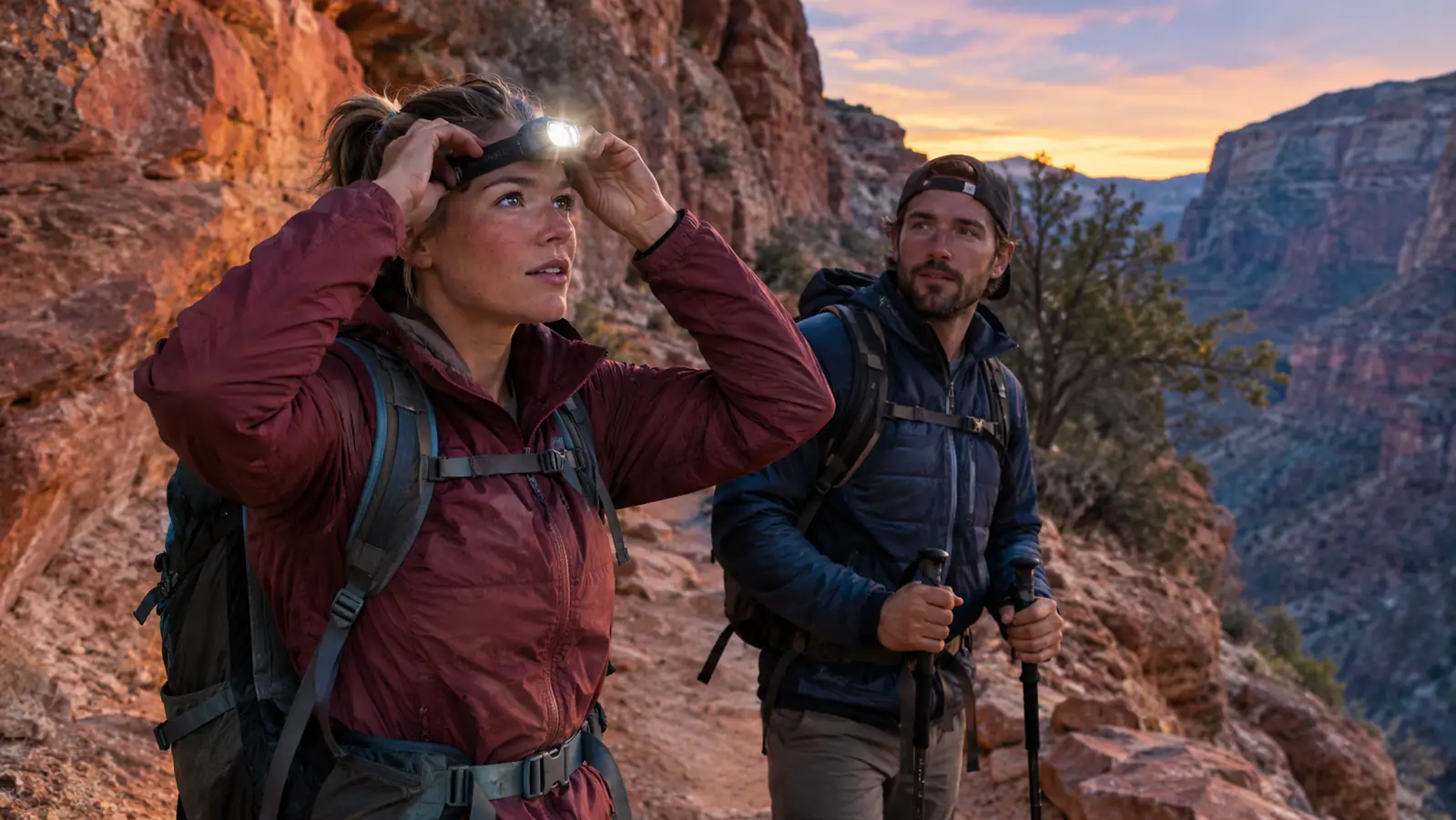
Short answer first. For hiking, the Lepro rechargeable headlamp is the light I take, and most nights it is not a close call. A handheld flashlight wins in three honest places, and I will give it all three. But the thing that decides this for me happens on a switchback above Red Rock Canyon at dusk, when my left knee has started its usual complaint about the downhill and both of my hands are on trekking poles. A light strapped to my head follows my eyes. A light in my hand follows my hand. On rough ground those are not the same thing.
I am Marisol Reyes. I am 58, retired from a school office, and I live in Henderson, Nevada, which puts Red Rock Canyon about twenty minutes from my kitchen and Mount Charleston a little further up the road. Ray, my husband, comes along on weekends. We do day hikes, four to ten miles, and we cut the timing close more often than I would like, which means the last mile happens after sunset more often than I would like too. That is how I ended up carrying a flashlight on some hikes and wearing the Lepro on others, and how the difference stopped being theoretical for me.
| Lepro Headlamp | Handheld Flashlight | |
|---|---|---|
| Hands free on rough ground | Stays on your head, both hands free for poles and scrambles | One hand is occupied the whole evening |
| Light where you look | Beam follows your eyes when you turn your head | Beam follows your hand, a beat behind your glance |
| Picking out a marker far ahead | 2000 lumens with adjustable focus, strong at close and mid range | A larger reflector throws a tighter beam down a long sightline |
| Cooking and camp chores | You tilt your head down at the stove, and shine into faces at close range | Set it down, aim it at the task, leave it there |
| Weight carried | 75 g, and your neck carries it rather than your palm | The weight sits out at the end of your arm, where it tires faster |
| Reading a map at close range | Six modes including flood and a red light for close work | Often one hard beam that washes out paper |
| Handing the light to someone else | Off your head means you are both standing in the dark | Pass it over and keep your own footing |
| Charging | USB rechargeable, up to 15 hours of continuous light on a charge | Varies by model, and plenty still run on disposable cells |
| Rain and knocks | Impact and water resistant | Depends entirely on the model you bought |
Where the Lepro Headlamp Wins
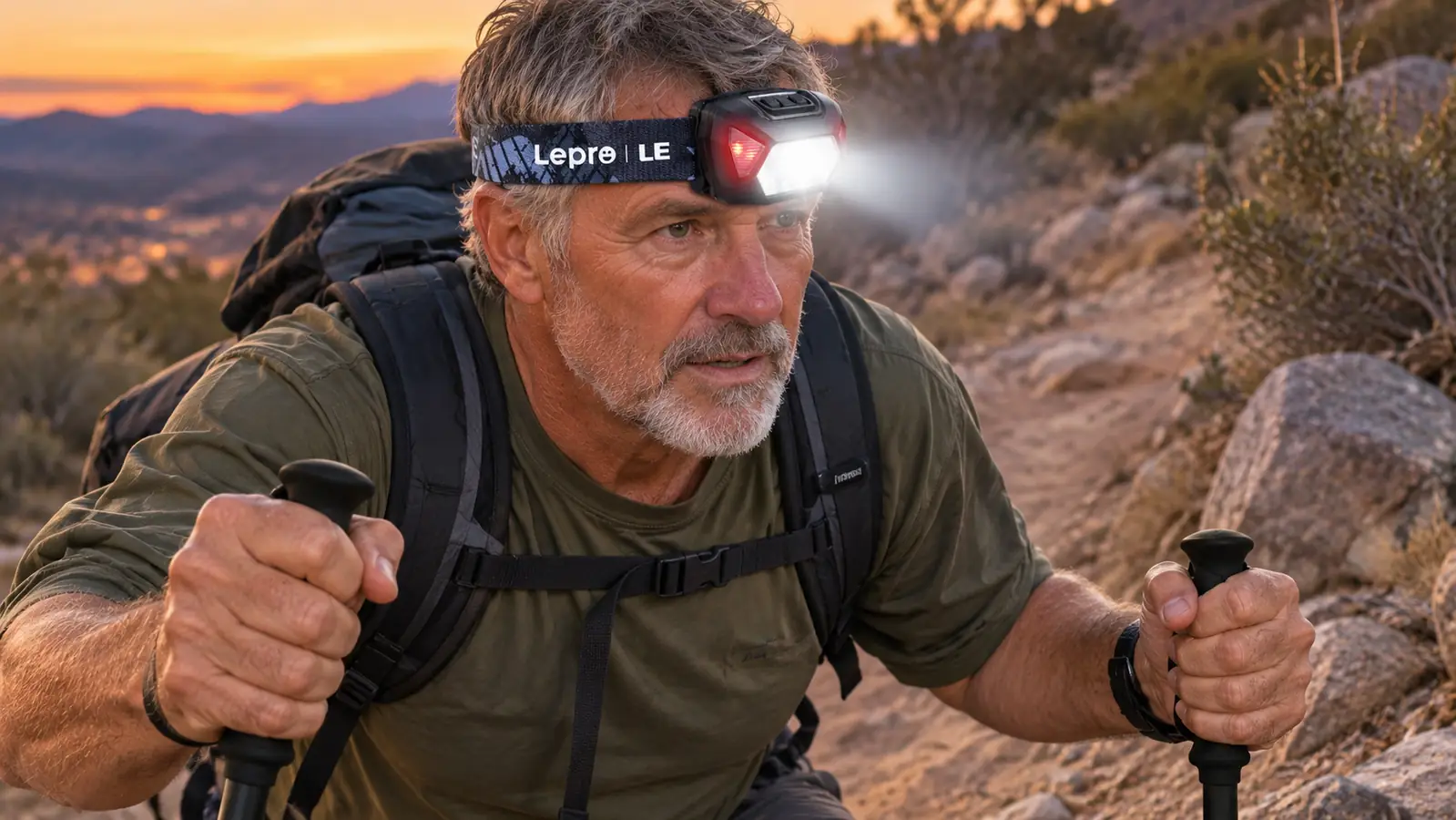
Hands. That is the whole argument in one word, and the rest is detail. On the uphills out of Ice Box Canyon I use both poles, and on the short scrambles I use both hands. A headlamp leaves them free. The unit weighs 75 grams, light enough that I forget it is up there until I switch it on, and it rides on the head band that comes in the box with no separate mount to buy. I have worn it over a ball cap and over bare hair, and it stayed put both ways. Last March on the Calico Hills traverse I proved the point without meaning to. I had a flashlight clipped to my hip belt and both poles in my hands, and that flashlight stayed on my hip for the whole forty minutes of the descent, because getting it out meant letting go of a pole on ground I did not want to bend over on. The tool you cannot reach is the tool you do not use.
Then there is aim. A headlamp points where you look, so when I hear gravel shift ahead and turn my head, the light is already there. With a flashlight I turn my head and the beam stays where my hand is, and there is a half second where I am looking at something I cannot see. Multiply that by a hundred small checks on a rocky descent and the flashlight starts to feel like a conversation you keep having to restart. The flood setting spreads a wide pool for close work like reading a map or finding a foothold, and the spot settings punch further out when I want to see what is coming.
Power and weather matter too. This is where the Lepro earns a permanent spot in the pack rather than a shelf at home. It is USB rechargeable, and Lepro rates it at up to 15 hours of continuous light on a charge, so a long evening does not end with me swapping cells by feel in the dark. It is rated impact and water resistant, which I have tested in the way you would expect, meaning I have been caught in cold rain on the Mount Charleston road and it kept working. The head band and a USB cable are both in the box, and the body is 2.48 by 1.77 by 1.38 inches, small enough to vanish into a hip pocket when I am not wearing it.
Every time I pointed the flashlight at my feet I lost the trail. Every time I looked up to find the trail, I lost my feet.
Where the Handheld Flashlight Wins
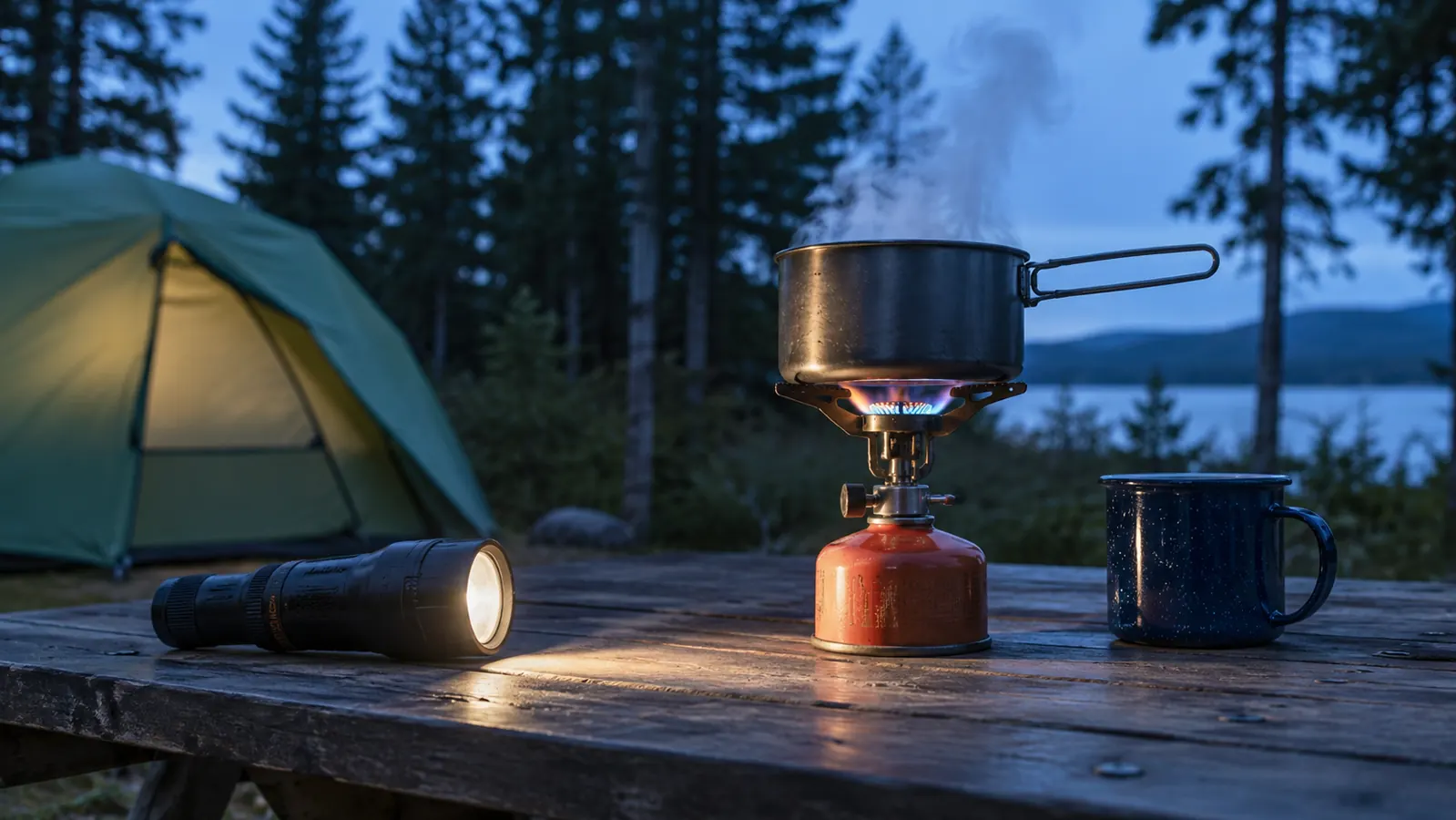
Setting up camp. This is real and I will not pretend otherwise. When I am at a picnic table at the Grand Canyon campground, or crouched over a stove with a pot in one hand, a headlamp is awkward. I have to tilt my head down at whatever my hands are doing, and if Ray walks up to talk to me I shine a light straight into his face from two feet away. A flashlight sits on the table, points where I aim it, and stays there while my hands work. At that same campground in April I cooked two dinners with Ray's flashlight standing on its tail aimed at the stove, and I never once had to tilt my head. The pot handle, the lid, the matches, all of it lit exactly where I needed it, and my hands stayed on the food. I tried the same thing with the headlamp the next night and ended up with the beam in a passing camper's eyes.
Reach. A full size handheld with a big reflector will out throw a headlamp down a long straight sightline. At Bryce, walking the rim back toward the car after sunset, I want to pick out a trail marker a couple hundred feet ahead, and a flashlight does that with a hot center that stays bright at distance. The Lepro has adjustable focus and a long reach of its own, and 2000 lumens is genuinely bright, but a light designed to sit on your forehead is not built to be a searchlight. If your evening is mostly open ground and long views, that gap shows up.
Sharing. Ray and I own one good flashlight and two headlamps, and the flashlight is the one that gets handed back and forth. If he walks ahead to check a junction, he takes it and I still have my own light. With a single headlamp, handing it over means one of us stands in the dark. A flashlight is also easier to aim at a map spread on a rock without lighting up the whole canyon, which matters more than you would think when someone fifty feet away is trying to sleep.
Both hands free for the part of the trail that hurts
The Lepro rechargeable headlamp weighs 75 grams, runs up to 15 hours on a USB charge, and arrives as a two pack with the head band and cable in the box.
Amazon Check Today's Price on Amazon →The Two Evenings That Settled It
Two nights did most of the convincing. The first was a late start on the Calico Basin loop, a short one I know well enough to be careless on. We came off the last ridge with maybe twenty minutes of usable light, and I had a flashlight in my hand because I had left the headlamp in the car. The gravel on that stretch is small and loose, the kind that rolls under a boot instead of packing down, and it is exactly the surface that punishes you for looking at the wrong thing. I knew that. I still did it. Every time I needed to check my footing I pointed the light down, which meant I could not see where the trail went. Every time I looked up to find the trail, I lost my feet. I went down on one knee on that gravel patch. Not badly, but enough to stop being polite about it. Ray was behind me and had the good sense to say nothing until we reached the car.
The second was a rim walk at the Grand Canyon, the kind where you underestimate how fast the light goes once the sun drops behind the wall. That night Ray carried the flashlight and I wore the Lepro. He picked out the markers ahead while I watched my own feet, and between the two of us we walked out without drama. That is the honest version of this comparison. It is not that one tool is better in every possible way. It is that on a trail, the hands free light carries more of the job.
There is a smaller thing I did not expect to care about. The Lepro has six modes, including spot on high and low, flood on high and low, and a red light. I use the red light at camp and at the trailhead after dark, because it lets me see my pack and my map without blowing out my night vision for the next ten minutes. A single white beam at full brightness does the opposite. I did not think that mattered until I started hiking in places where the stars are the only other light.
The Details People Ask Me About
Weight on the head. Seventy five grams is not nothing, and I notice it for the first half mile while the band settles. After that I stop noticing, and I have worn it for four hours at a stretch without a headache. The band adjusts with a single pull at the back. If you are sensitive to pressure on your forehead, wear it over a thin cap the first few times and see how it sits.
Modes and brightness. The listing rates it at 2000 lumens, which is far more light than I need for walking, so most of the time I am on a low spot or the flood setting. High is for the moments when something moves off the side of the trail and I want to know what it is. The adjustable focus lets me tighten the beam for distance or widen it for a pool of light around my feet, and I switch between those more than I switch brightness.
Charging. It charges over USB, and the batteries are lithium and come with the unit. The two pack matters more than I expected, because one lives in the Outback and one lives in my hiking bag, so there is always a charged light in the vehicle on the drive out to a trailhead. I charged both units the night before we left for Zion in April, and both still had light left when we got home four days later, after maybe an hour of use each evening between them. That is not a scientific test. It is the reason I stopped carrying spare batteries. Fifteen hours of rated runtime means I charge it roughly once a month in normal day hike use.
Who Should Buy Which
Buy the Lepro headlamp if your hikes tend to run long, if you use trekking poles, if you scramble, or if you are the person who ends up walking the last mile in the dark more often than planned. It is also the right pick if you hike with someone else and want your own light rather than a shared one. Anyone with knee trouble, mine included, gets more out of a light that leaves both hands on the poles where they belong. The 75 gram weight and the up to 15 hour runtime suit a full day out without a charging plan.
Buy a handheld flashlight if your evenings are mostly stationary. Car camping, cooking at a table, reading in a tent, walking a flat road, scanning a long open sightline for a marker. It is also the better loaner, and the better light to set down and leave pointing at something while you work. Honestly, if you already own a decent flashlight, do not throw it out. Ray still carries one on every trip. It just is not the light either of us wants on our head when the trail turns rocky.
If your hike is going to end after sunset, take the light you can wear
Six modes including a red light for map reading, 2000 lumens with adjustable focus, and it charges off the same cable as everything else in your pack.
Amazon Check Today's Price on Amazon →