

The first time I ran out of water on a hike, it was my own fault. I had planned a six mile loop at Red Rock Canyon, drank most of my bottle by mile four, and spent the last two miles thinking about nothing else. Ray offered me some of his and I waved him off, which was pride and also not very smart.
These days I carry a LifeStraw Personal Water Filter on every warm weather hike, and I have carried it long enough to have real opinions about it. Not the kind you form reading a spec sheet. The kind you form kneeling at a creek that looks a little questionable and deciding whether you are actually going to drink from it. This is what a full season of trail use looks like, including the parts I do not love.
The Quick Verdict
Weighs almost nothing, needs no batteries, and turns a dry stretch of trail into a non-issue. The catch is that drinking through it takes patience and a water source you can actually reach.
Amazon Check Today's Price →One and a half ounces that ended my water math
I stopped counting bottles against miles. The LifeStraw weighs 1.62 ounces, requires no electricity or battery, and works the moment you kneel down at a creek. It lives in the side pocket and stays there.
Amazon Check Today's Price on Amazon →How I've Used It
I bought mine for one specific problem: the long dry stretches on the trails near home. Most of my hikes run four to ten miles, and on a hot morning in Henderson I can go through a bottle before I am halfway done. Carrying three bottles is heavy and dull. Carrying one bottle and a filter is lighter, and it gives me something to do at a creek besides look at it.
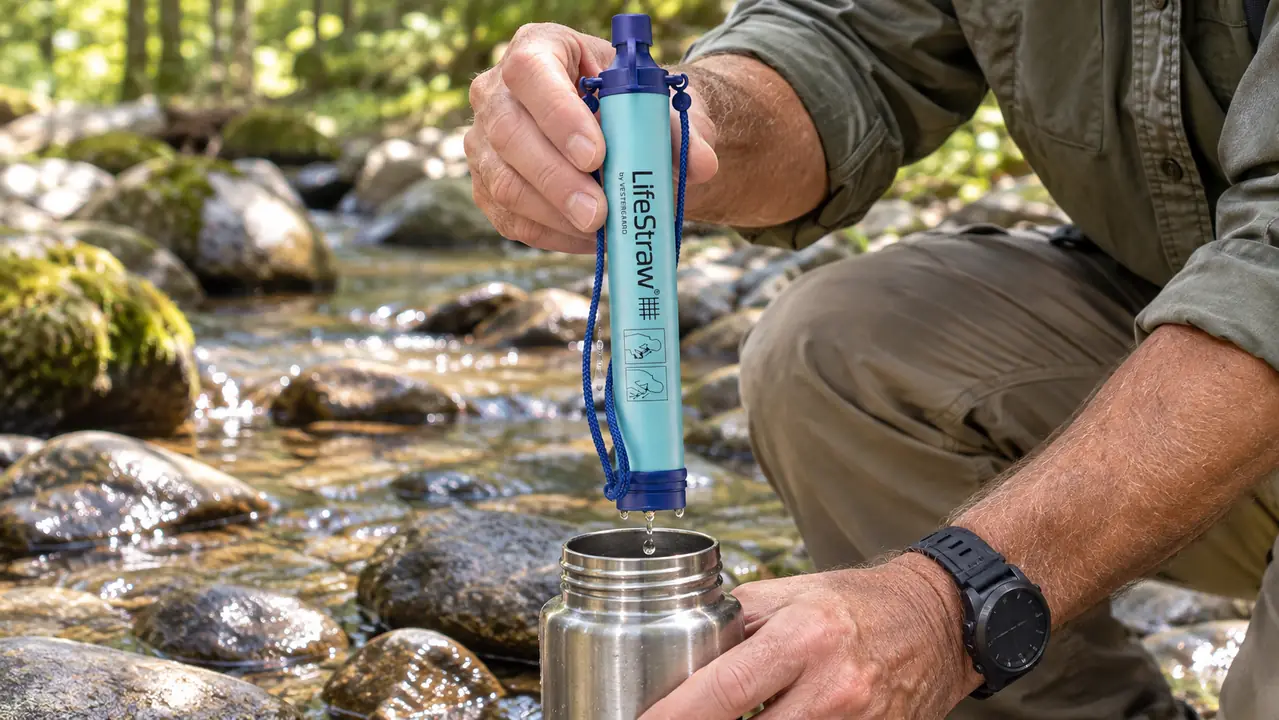
The first place I tested it was a spring crossing up on the Mount Charleston side, where the water runs cold and clear and where I had walked past for years without ever drinking from it. I filled my bottle, put the straw in, and took a pull. Nothing happens for a few seconds. Then water arrives in a slow, even stream, and it tastes like water. Not treated water, not chemical water. Water.
Since then it has gone with me to Zion and Bryce on our spring road trip, riding in the side pocket of my pack between the sunscreen and a smashed granola bar. It has been used in creeks, in a shallow pool I would not have touched five years ago, and once in a puddle-fed trickle near the Grand Canyon rim that was doing its honest best. Ray tried it too, mostly out of curiosity, and he is harder to impress than I am.
What changed is less about the gear and more about the planning. I used to count bottles before a hike and worry. Now I count water sources, which is a much shorter list and a much calmer exercise. If there is a creek at mile five, I carry one bottle. If there is not, I carry three and the filter rides along as insurance. Either way I stop thinking about it, and stopping thinking about it is most of what I wanted.
What the Filter Actually Does
The LifeStraw uses a hollow fiber membrane. Water goes in one end and comes out the other, and the membrane catches what you do not want. The listing states it removes 99.999999% of waterborne bacteria, including E. coli and Salmonella, and 99.999% of parasites. It also removes the smallest microplastics found in the environment, down to one micron, and reduces turbidity.
There is no electricity and no battery involved. That matters more to me than it probably sounds. I have a headlamp that dies, a phone that dies, and a watch that wants charging every third day. Gear that only works when something else is charged is gear I will eventually carry for no reason. This just sits in the pack and works.
The listed lifetime is 1,000 gallons, which the brand puts at about 4,000 liters, and the listed low temperature limit is 1 degree Celsius. I cannot verify a number like 1,000 gallons from one season of use and I am not going to pretend I can. What I can tell you is that mine has handled somewhere around thirty or forty bottles and it pulls exactly the way it did the day I opened it.
The one thing it does not do is improve taste. There is no carbon stage here, so if the water tastes like minerals it will still taste like minerals, and if it is cloudy the filter reduces the cloudiness without turning a creek into something from a bottle. It removes the things that make you sick. That is a narrower promise than some filters make, and it is the promise I actually care about.
What It's Like to Drink From on the Trail
Drinking through a hollow fiber straw takes work. You are pulling water through a very fine membrane, so it arrives slowly. A full bottle takes a couple of minutes if you are thirsty and impatient, and less if you sit down and treat it like the rest stop it is.
The technique I settled on is simple. I stop, I sit, I fill the bottle, and I drink in long slow pulls while I look at whatever is in front of me. That is a better way to hike anyway. People who complain about the flow rate are usually trying to drink while walking, which is like trying to read a map while jogging.
The first pull of the season always surprises me. You expect a mouthful and you get a trickle. By the second bottle you have adjusted your expectations and it stops being annoying. By the fourth you have forgotten it was ever anything else.
One practical note that has nothing to do with the filter: the bottle matters more than you would think. A wide-mouth bottle is easier to fill from a shallow creek than a narrow one, and a bottle you can set down on a rock without it tipping saves you a wet knee. I switched to a plain wide-mouth stainless bottle and it made the whole process calmer.
Ray's take, for what it is worth, is that it is fine but slow. He is not wrong. He also drinks close to a gallon on a hike, so his perspective is a little skewed. For a normal person drinking a bottle at a time, the pace is manageable.
The Water Sources I've Used It On
Not all water is worth filtering and not all water is reachable. The best sources I have found are the spring crossings up on Mount Charleston, where the water is cold and moving and the bank is easy to kneel on. Moving water, an easy approach, and a rock to sit on is the whole checklist.
The worst was a shallow pool off a side trail near the canyon, warm, still, and full of leaves. I did not drink from it with the filter and I would not have. A membrane removes bacteria and parasites. It does not fix water that has been sitting in the sun all day. Knowing the difference is part of using one of these responsibly, and it is the part that no spec sheet teaches you.
The middle ground is the creek at mile five on the South Loop, which runs most of the year and dries to nothing by July. When it is running I plan around it. When it is not, I do not. The filter did not teach me that. It just made the running months useful.
How It Has Held Up Over a Full Season
Mine lives in the side pocket of my pack, which means it gets bounced, squeezed, and occasionally sat on. After a full season it looks the same as the day it arrived. No cracks, no leaks, no change in the pull. There is not much to break on a single piece of gear with no moving parts, and that is most of the appeal.
The weight is the quiet advantage. At 1.62 ounces it is lighter than the water I would otherwise carry to cover the same gap. Two extra bottles runs close to three pounds. The filter is an ounce and a half. That is the arithmetic that keeps it in the pack on hikes where I do not expect to need it.
Maintenance amounts to shaking it out and letting it dry. That is the whole routine. My knee brace has a more involved care regimen, and the knee brace does not remove bacteria. I like gear that does not ask anything of me, and this asks almost nothing.
I have not had to replace anything on it and I do not expect to. When it finally reaches the end of its rated life there is no cartridge to swap out, which is worth knowing before you buy. The whole unit is the filter. That is a simple design and it makes for a simple exit.
Where It Falls Short
You need a water source you can physically reach and put the straw into. That sounds obvious and it eliminates a lot of trails. A filter does not help on a ridge with no water for six miles. On those hikes I carry full bottles and the filter rides along as insurance rather than as a plan.
The other limitation is the one nobody enjoys discussing: you have to be willing to drink from a creek. Some people never get comfortable with it and I understand, because I was one of them for years. What changed my mind was understanding what the membrane actually removes, which is most of what I used to worry about.
And it is a personal filter. One person drinks at a time. Ray and I pass it back and forth and that is fine, but a group of five would find it tedious. This is a straw, not a group water system, and treating it like one will make everyone grumpy.
What I Liked
- 1.62 ounces, lighter than the water it replaces
- No electricity or battery required, works the moment you kneel down
- Rated to remove 99.999999% of waterborne bacteria and 99.999% of parasites
- Rated for 1,000 gallons, roughly 4,000 liters, of use
- No moving parts and no maintenance routine beyond shaking it dry
- Removes microplastics down to one micron
Where It Falls Short
- Slow flow, a full bottle takes a couple of minutes of steady pulling
- No carbon stage, so it does nothing for taste or minerals
- Requires a water source you can physically reach with the straw
- One person at a time, awkward for larger groups
- Not a fit for long waterless stretches where no filter helps
The filter is an ounce and a half. Two extra bottles runs close to three pounds. That arithmetic is why it never leaves my pack.
Who This Is For
Day hikers who cover four to ten miles and pass water along the way. Warm weather hikers in the desert Southwest, where the dry stretches are long and the springs are rare but real. Anyone who has done the bottles against miles arithmetic and gotten tired of it. If you hike the same handful of trails often enough to know where the water is, this is the least fussy way to use that knowledge.
It is also a sensible thing to keep in the car. I keep a small kit in the silver Subaru Outback for the road trips to Utah and Arizona, and a filter that needs no power belongs in it. It weighs an ounce and a half. There is no good reason not to have one in the glovebox.
Who Should Skip It
Backpackers on long waterless stretches should look at a gravity or pump system with more capacity. Groups of three or more will find passing a straw around tiresome. Anyone who wants their water cold, cleared of sediment, and tasting like nothing should buy a different kind of filter, because this one makes no such promise and never claimed to.
And if you hike where it regularly drops below freezing, pay attention to the 1 degree Celsius rating before you count on it in winter. Mine has never been tested in real cold and I would rather tell you that than guess. A filter that freezes is a filter you should not trust, and that is true of most of them.
The ounce and a half that lives in my pack's side pocket
No batteries, no pumping, no setup, and it has never failed to work when I knelt down at a creek. If you hike where water runs, this is the simplest version of that idea I have found.
Amazon Check Today's Price on Amazon →