
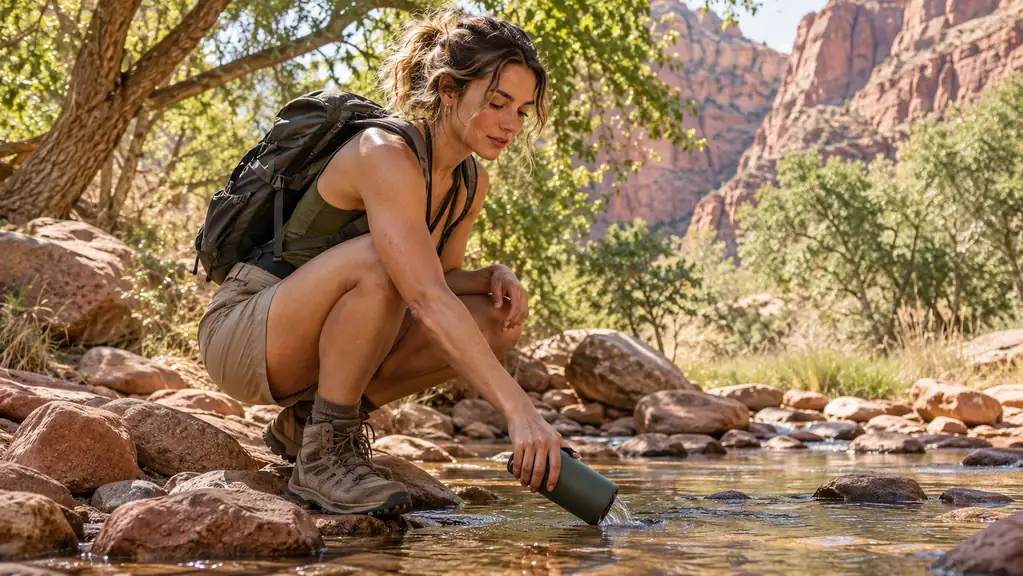
Two water filters come up every time a day hiker asks what to carry: the LifeStraw Personal Water Filter and the Sawyer Mini. I have used both, on the same trails, in the same heat, and the short answer is that they solve the same problem in different packages. The LifeStraw is one object you drink through. Nothing to assemble, nothing to lose, nothing to remember at the trailhead. The Sawyer Mini is a small filter body that does more, once you add a squeeze pouch and a backflush syringe to your pack.
So here is the short answer before the long one. If your hikes look like mine, 4 to 10 miles at Red Rock Canyon or up Mount Charleston with my husband Ray, the LifeStraw is the one that earns its place in the side pocket. It weighs 1.62 ounces, it needs no battery and no electricity, and the box contains the filter and nothing else. If you are filtering for two people on longer days, or you want one filter that keeps going for years of refills, the Sawyer Mini has the better numbers on paper. Below is where each one actually wins.
| LifeStraw Personal | Sawyer Mini | |
|---|---|---|
| Filtration | Hollow fiber membrane rated for 99.999999% of bacteria and 99.999% of parasites | 0.1 micron hollow fiber, the finer pore size of the two |
| Weight | 1.62 ounces | About 2 ounces |
| How you drink | Straight through the filter, no pouch or bottle needed | Squeeze pouch, inline in a bottle line, or sipped as a straw |
| Rated capacity | 1,000 liters before the membrane is spent | Up to 100,000 gallons |
| Setup and upkeep | Nothing to assemble, the box holds the filter and nothing else | Backflush with the included syringe to hold the flow rate |
| Cold conditions | Listing gives a lower operating limit of 1°C | Same hollow fiber weakness, ice inside the membrane ruins it |
| Best for | One person on 4 to 10 mile day hikes | Two or more people, longer trips, years of refills |
Where the LifeStraw Wins
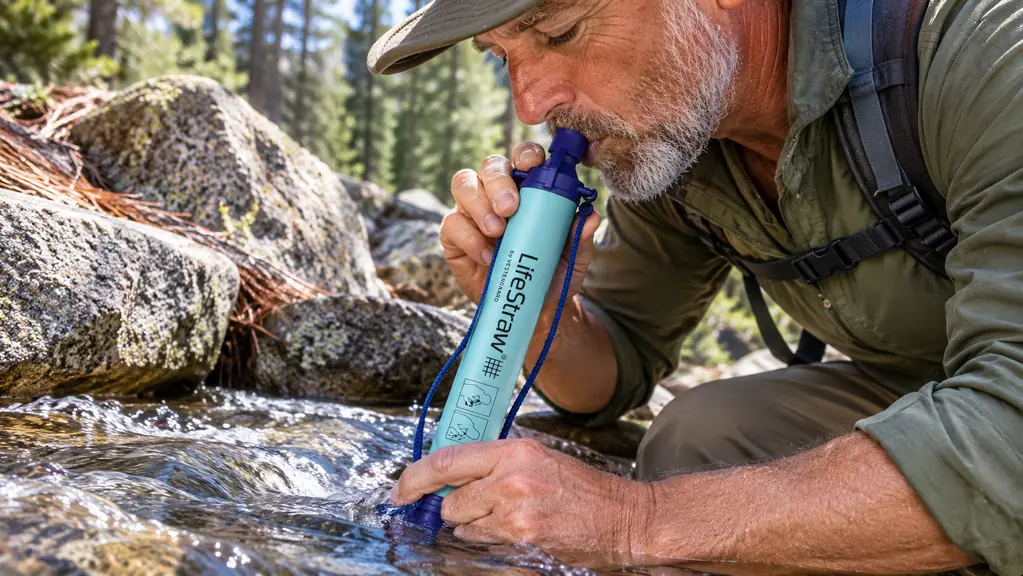
The first win is that there is nothing to do. I pulled the LifeStraw out of my pack at a seep off the Mount Charleston trail, put the end in the water, and drank. No pouch to fill, no cap to unscrew, no hose to prime. Ray and I have both had mornings when we were tired enough to skip a step, and a filter with fewer steps is a filter you actually use. It weighs 1.62 ounces, the listing says it needs no electricity or battery power, and that is a polite way of saying there is nothing to charge and nothing to fail.
The second win is the drinking itself. A straw filter lets you drink at your own pace while you are standing in the creek, which matters when your hands are cold or your knee is sore and you do not want to balance a pouch on a wet rock. The listing rates it to remove 99.999999% of bacteria and 99.999% of parasites, it pulls microplastics down to 1 micron, and it reduces turbidity. For water coming out of a clear mountain seep, that is more than enough. It also means no syringe rolling around in the bottom of a pack, because a syringe is not in the box.
One cold October morning on the Cathedral Rock trail, my car thermometer read 41 degrees and my hands were stiff enough that unscrewing a cap felt like a project. I knelt at the seep, put the end in the water, and drank until I was not thirsty. Ray had walked past that same seep twice on earlier trips without stopping, because he had nothing to drink from and did not want to bother with the pump we used to carry.
Where the Sawyer Mini Wins
The Sawyer Mini wins on the number that matters most if you worry about fine sediment and protozoa: its hollow fiber membrane is 0.1 micron. That is the finer pore size of the two, and it is why the Mini has the following it has among people who filter questionable water. If I were pulling from a stock tank or a muddy creek below a pasture, I would rather have the finer membrane between me and the water. I am not going to pretend the LifeStraw wins a pore size argument it does not win.
It also wins on total life. The Mini is rated for up to 100,000 gallons, which is a number I cannot really picture. The LifeStraw listing gives 1,000 liters. For a day hiker who gets out 30 times a year and refills a bottle at each one, 1,000 liters is still years of water, but the gap is real and I will say so plainly. The Mini also offers options the straw does not: squeeze pouch, inline in a bottle line, or a gravity setup at camp. A group of three can filter one pouch and pour for everyone.
The filter that needs no pouch, no syringe, and no setup
For one person on a 4 to 10 mile day, the LifeStraw is 1.62 ounces of nothing to think about. Rated for 1,000 liters, 99.999999% of bacteria removed, no battery and no parts to lose.
Amazon Check Today's Price on Amazon →How I Tested Both on the Trail
My testing is not a lab. It is a 58 year old woman with a sore left knee, a silver Subaru Outback at the trailhead, and a habit of hiking 4 to 10 miles at a time. I carried both filters on the same Mount Charleston days, filled both from the same seeps and creeks, and paid attention to the things that actually bother me: how long a filter takes to drink through, whether it fits in a hip belt pocket, and whether I would still bother with it on a hot afternoon when I am ready to be back at the car.
I keep a note on my phone with the date, the miles and the source, which is the closest thing to a lab notebook I have. The first line reads Saturday, 6.2 miles on the South Loop at Red Rock, 91 degrees at the turnaround, both filters filled from the same seep. The second line is a Mount Charleston morning in the low 50s, 7 miles with the pack on. Two filters, same water, same tired legs.
The other half of my testing is memory, which is not a scientific measure but is the one that keeps people hydrated. I have left a pump filter on the kitchen counter and I have left a pouch on the tailgate. A straw filter is hard to forget because it lives in the pocket where the map goes. That sounds like a small thing until it happens to you at a trailhead 40 minutes from the nearest store.
I also watched how each one behaved after a week of sitting unused in a pack. Hollow fiber membranes do not care about resting, but flow rate does drop once sediment builds up. The Mini comes back with a syringe you push through the other way. The LifeStraw ships as a single piece, so I rinse both ends and keep it out of grit. There is a full long-term review of the LifeStraw on this site if you want more detail than a comparison allows.
Flow Rate and Cloudy Water
Both filters slow down when the water is silty, and neither one is a purifier for chemical contamination. What I noticed is that a straw filter slows you down rather than stopping you. You drink until the pull gets hard, then you walk to a clearer spot and drink again. With a squeeze filter you feel the resistance in your hand and you either squeeze harder or stop. On a day hike I prefer the first experience, honestly, because it never turns into a chore you start avoiding.
The silt test came after a rain, when the drainage in Calico Basin ran the color of weak coffee. The straw got harder to pull after about ten seconds, so I moved 20 feet upstream to where the water ran clear over gravel and drank there. The Mini, filled from the same brown pool, needed a backflush that evening before it flowed well again. Neither result surprised me, and neither one ruined the day.
The LifeStraw listing says it reduces turbidity, and the microplastic rating goes down to 1 micron, which is a real advantage on trails close to roads and towns. Red Rock Canyon sits near enough to the valley that I think about that when I fill from a seep along the scenic drive. Neither filter removes viruses, and neither removes dissolved chemicals or salt. If the source is a ditch below a pasture or a pond below a road, the right answer is to walk to a different source, not to wish you had brought a better filter.
What Neither Filter Does
Neither of these is a purifier. The word gets used loosely in reviews, so here it is plainly: hollow fiber removes bacteria and protozoa, and both of these are hollow fiber. Viruses are smaller than the pores and pass through. If you are hiking somewhere that human waste is a genuine concern, that is a separate conversation and it usually means a chemical or ultraviolet step alongside the filter.
Neither one handles salt water, and neither one makes water taste better. They also do not remove agricultural chemicals, which is why I will not drink from a creek that runs through somebody's field. The best filtration decision on any hike is choosing the source. The filter is the backup plan for the day the source you have is the only one you get.
1.62 ounces, no battery, nothing in the box but the filter, and 99.999999% of bacteria removed. On a day hike that is the whole argument.
The Day Hike Scenario That Decides It
Picture the ordinary version of a hike. You park at a trailhead off the highway, you walk 5 miles, and you finish your one bottle before the turnaround. There is a seep at mile 3 that runs most of the year. With the LifeStraw you stop for 90 seconds, drink until you are not thirsty, and keep walking. That is the entire interaction. No pouch, no pouring, no packing a wet filter next to your sandwich.
Now picture the version where Ray and I bring a friend and we are out for 9 miles with a long climb at the end. Two of us are drinking, and I am not handing my straw to somebody else's mouth. Either everyone carries a filter, or one person carries the Mini and a pouch and pours for the group. That is the moment the Sawyer Mini stops being extra weight and starts being the sensible choice.
That long day was 9 miles out of a canyon trailhead with a friend who drinks more than either of us. Three bottles were gone by mile 5. I had the LifeStraw in my hip belt pocket and used it at two seeps, but I cannot hand a straw to somebody else and pretend it is clean afterward. Ray carried the Mini and a pouch that day and poured for the friend. That is the difference in one sentence.
That is the fork in the road, and it has nothing to do with which filter is better built. It is one person and short miles, or more than one person and long ones. I have done both, and the answer changed with the trip, which is why both live in a bin in the garage and only one of them goes in the pack on a Saturday.
Who Should Buy Which
Buy the LifeStraw if you hike alone or with one other person, if your days run 4 to 10 miles, and if you want something that lives in a pocket and asks nothing of you. It suits desert seeps and mountain creeks, hot weather, and anyone who has ever left a pouch at home. It also suits the hiker who wants a filter in the car for emergencies and does not want to think about maintenance until the day it is needed.
Buy the Sawyer Mini if you filter for a group, if you take longer trips where total capacity matters, or if you specifically want the finer 0.1 micron membrane and the flexibility of a squeeze or inline setup. It adds a couple of ounces and a small routine, and it returns years of water. Neither choice is a mistake. The mistake is carrying neither and drinking straight from a seep at mile 6 because the bottles ran out.
One pocket. 1.62 ounces. Every day hike.
The LifeStraw Personal Water Filter needs no battery, no pouch and no setup. It is rated for 1,000 liters and it disappears into a hip belt pocket until the moment you need it.
Amazon Check Today's Price on Amazon →