

The first time I carried the Osprey Daylite Plus up the Calico Tanks trail at Red Rock Canyon, I forgot I had it on. That is a compliment, and it is also the reason I kept using it for months before I sat down to write this. I am 58. My left knee gets sore on long downhills, and I hike 4 to 10 miles at a time, mostly with my husband, Ray. The Daylite Plus is sold as a commuter backpack. I treated it as a daypack. Those two jobs are close, but they are not the same, and the gap between them is the whole story of this honest review.
I have carried it on Mount Charleston in summer, on the rim at Bryce, and on a cold morning at the Grand Canyon when the wind made the water bottle in the side pocket feel like a bad idea. I have also carried it through the Las Vegas airport and into a grocery store, which tells you something about how Osprey designed it. It is light, it is simple, and it does not try to be a technical mountaineering pack. What nobody tells you is that the same choices that make it a good commuter pack are the ones that limit it on a long trail. It is not a bad pack. It is a specific pack, and you need to know which specific one before you buy.
Here is the short version. If you want a light daypack for 4 to 8 miles, with room for a jacket, lunch, water, and a 14 inch laptop sleeve you will never use on the trail, it works. If you want a pack that carries 20 pounds of camera gear and layers without digging into your shoulders, keep looking. I will get into both sides, because an honest review that only lists the good parts is not a review. It is an ad with better grammar.
The Quick Verdict
A light, well-made commuter pack that handles short day hikes well, but it runs out of support and space on longer or heavier days.
Amazon Check Today's Price →See the Osprey Daylite Plus before you match it to your trail load
Check the dimensions, pocket layout, and current listing, then compare it to what you actually carry on a 4 to 8 mile day.
Amazon Check the Osprey Daylite Plus on Amazon →How I've Used It
My testing is not a lab test. It is a retired school office manager with a sore knee and a husband who walks faster than he thinks he does. Ray and I do day hikes, usually 4 to 10 miles, and we drive our silver Subaru Outback to the trailhead. I have used the Osprey Daylite Plus on Red Rock Canyon's easy washes and on the switchbacks at Mount Charleston. I have used it on a Zion trip where the shuttle line was longer than the trail. I have not taken it backpacking overnight, because I do not backpack overnight. That matters. This pack is not built for that, and I am not going to pretend I tested it that way.
A typical load for me is a light jacket, a lunch, two water bottles, a small first aid kit, sunscreen, my phone, and a folded map. In cool weather I add a beanie and a pair of light gloves. The pack swallows that load with room to spare. The dimensions are 9.4 inches deep, 11 inches wide, and 18.9 inches tall, and it weighs 1.3 pounds. That weight is the first thing you notice. It is light enough that I do not feel it before I put it on, and light enough that I forget it on the drive home. For a 58-year-old with a knee that talks to her on downhills, less weight is not a small thing.
I also used it as a commuter pack on a road trip, which is what Osprey says it is for. The padded sleeve fits up to a 14 inch laptop. I carried a tablet and a folder in that sleeve instead, and they stayed put. The interior organization kept cords and a small charger from turning into a nest. The pack has 5 pockets, and I used all of them. The zipper closure is simple and has not snagged. The water repellent finish shed a light rain at Bryce, and I did not need a cover for a 20 minute walk. I would not trust it in a real storm. Osprey calls it water repellent, not waterproof, and that is the right way to read it.
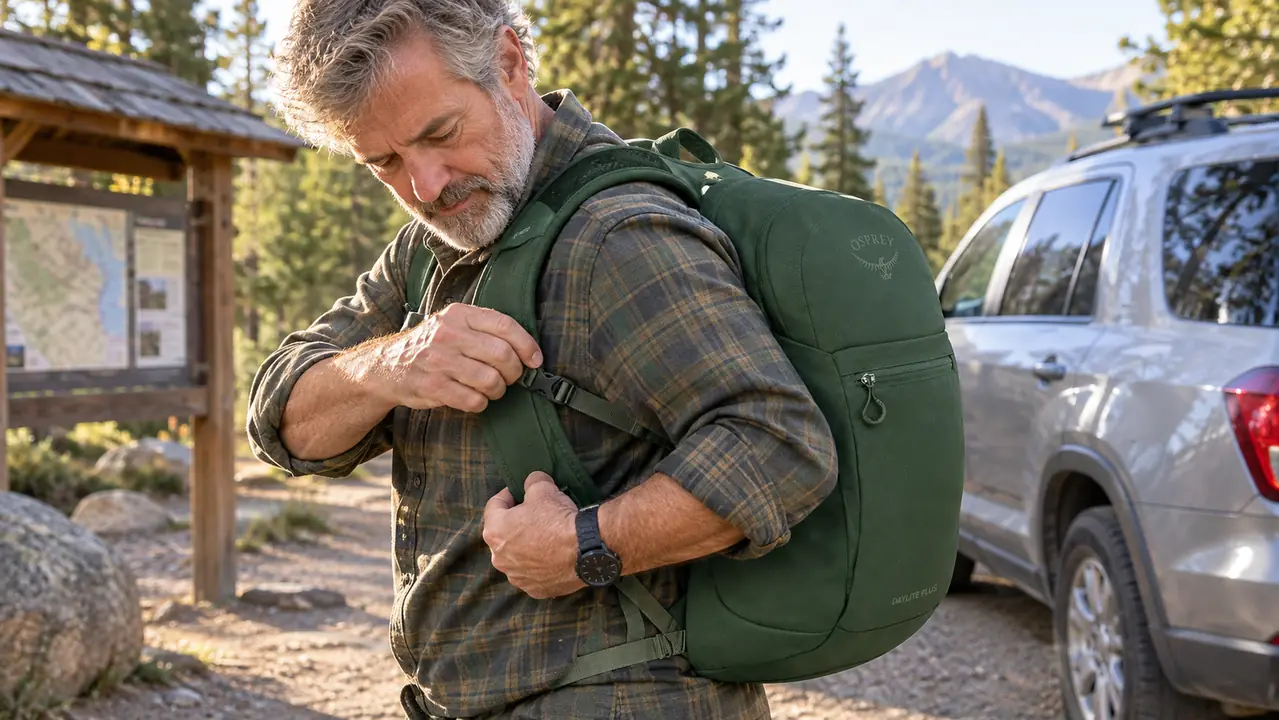
What the Osprey Daylite Plus Does Well
The first strength is weight. At 1.3 pounds, the Daylite Plus is not a burden. I have carried heavier packs on short hikes and felt the difference in my shoulders by mile three. This one disappears. The adjustable backstraps let me find a fit that keeps the pack close to my back without cutting into my neck. I am 5 foot 5 and Ray is 5 foot 11, and we both adjusted it without a struggle. The strap type is backstraps, and the adjustability is the feature I used most. It is not a harness system. It is a simple pair of straps, and for a light load on a 6 mile hike, simple is fine.
The second strength is the pocket layout. Five pockets sounds modest, but the placement works. I kept my map in the main compartment, my phone in a smaller pocket I could reach without taking the pack off, and my keys in a spot where they did not stab me through the fabric. The padded sleeve fits up to a 14 inch laptop, which is a commuter feature, but it also kept my folded map and a thin book from bending. On a trail, that sleeve is a flat, protected space. I did not need it for a computer. I used it anyway.
The third strength is the materials. The listing says 100 percent recycled polyester and bluesign approved. I cannot test that on a trail, but I can tell you the fabric has held up. I have set the pack down on sandstone, dragged it across a picnic table, and stuffed it into the back of the Outback more times than I can count. There are no tears at the seams I can see, and the zipper still runs clean. The care instructions say spot clean only, which is a limitation I will get to. For normal day hike dirt, a damp cloth has been enough. The Osprey build quality is the reason I kept using it after the first month.
The fourth strength is the way it carries a light load. I want to be careful here, because this is where the pack gets misread. The specs list backstraps and adjustability. They do not list a load-bearing hip belt, so I did not treat it as a pack for heavy loads. It does not carry 25 pounds like a backpacking pack. What it does is carry 8 to 12 pounds of day hike gear without swaying. I cinched the backstraps, and the pack sat still on the downhills. On the uphill sections, it stayed close enough that I did not feel it pulling me back. That is a real win for a pack this light.
At 1.3 pounds, the Osprey Daylite Plus disappears on a 6 mile hike. At mile 9, with a full water bottle and a jacket, you start to notice what it is not.
Where the Daylite Plus Falls Short for Me
The first shortfall is support on longer days. My left knee is the reason I care about this. On a 4 mile hike at Red Rock, the pack is fine. On a 9 mile day at Mount Charleston, with a jacket, lunch, and two bottles, I felt the straps across my shoulders by the last hour. The backstraps are adjustable and they stayed put, but they are not a harness. There is only so much a 1.3 pound pack can do. If you have shoulder or neck trouble, or if you like a hip belt to take weight off your shoulders, this is not the pack that will solve that. It is a light pack, and it carries like one.
The second shortfall is space once you add layers. The Daylite Plus is 18.9 inches tall and 11 inches wide, which sounds roomy until you put a puffy jacket in it. My light jacket fit fine. Ray's heavier fleece made the main compartment tight, and I had to move the lunch to the top. The 5 pockets help, but they are not deep enough for a large water bottle and a camera at the same time. For a summer day hike with a small load, it is enough. For a cold weather hike where you start in layers and peel them off, you will wish for a little more room.
The third shortfall is weather protection. Water repellent is not waterproof. I said that earlier, and I mean it. A light rain at Bryce beaded up and rolled off. A steady rain on a road trip made the fabric damp enough that I put my phone in a zip bag. The zipper is not a sealed waterproof zipper. If you hike in the Pacific Northwest or you get caught in a summer thunderstorm in the desert, bring a cover or a dry bag. Osprey did not claim this pack is a rain pack. The problem is that the water repellent finish makes it feel more protective than it is. That is a small trap, and I fell into it once.
The fourth shortfall is cleaning. The care instructions say spot clean only. That is normal for this kind of pack, but it means you cannot throw it in the washing machine after a muddy trip. I have wiped it down with a damp cloth and a little mild soap. The sandstone dust at Red Rock gets into the fabric, and a spot clean takes time. If you are the kind of person who wants to toss a pack in the wash and forget it, this one will ask more of you. It is not a deal breaker. It is a chore.
The Details That Matter on a Real Trail
The zipper closure is one of those details you do not think about until it fails. This one has not failed. It runs smoothly around the main compartment, and the pulls are easy to grab with one hand. I can open the pack while it is on one shoulder, which matters when I want a layer and do not want to set it down in the dirt. The 5 pockets are laid out well enough that I can find sunscreen without emptying the whole bag. The adjustable backstraps are simple to tighten on the move. None of this is flashy. It is the kind of design that gets out of your way, and on a trail, that is what I want.
The padded sleeve that fits up to a 14 inch laptop is the clearest sign that Osprey built this for commuters first. On a trail, I used it for a map and a thin notebook. It kept them flat and dry. On a road trip, I used it for a tablet. It is a good sleeve. But it also takes up space in the main compartment, and that space is part of why the pack feels smaller than its dimensions suggest. If you never carry a laptop, you are paying for a feature you will not use. You are also getting a flat, protected pocket that works for other things. That is the trade.
The 1.3 pound weight and the 9.4 by 11 by 18.9 inch dimensions are the numbers I would write on a card if I were shopping. The weight is the reason to buy it. The dimensions are the reason to pause. It is tall and narrow, not wide and deep. That shape fits a laptop and a jacket well. It does not fit a large camera cube or a big lunch box. I packed around the shape, and after a few trips I knew exactly what would fit. That is not a flaw. It is a fit issue. You need to know your load before you buy.
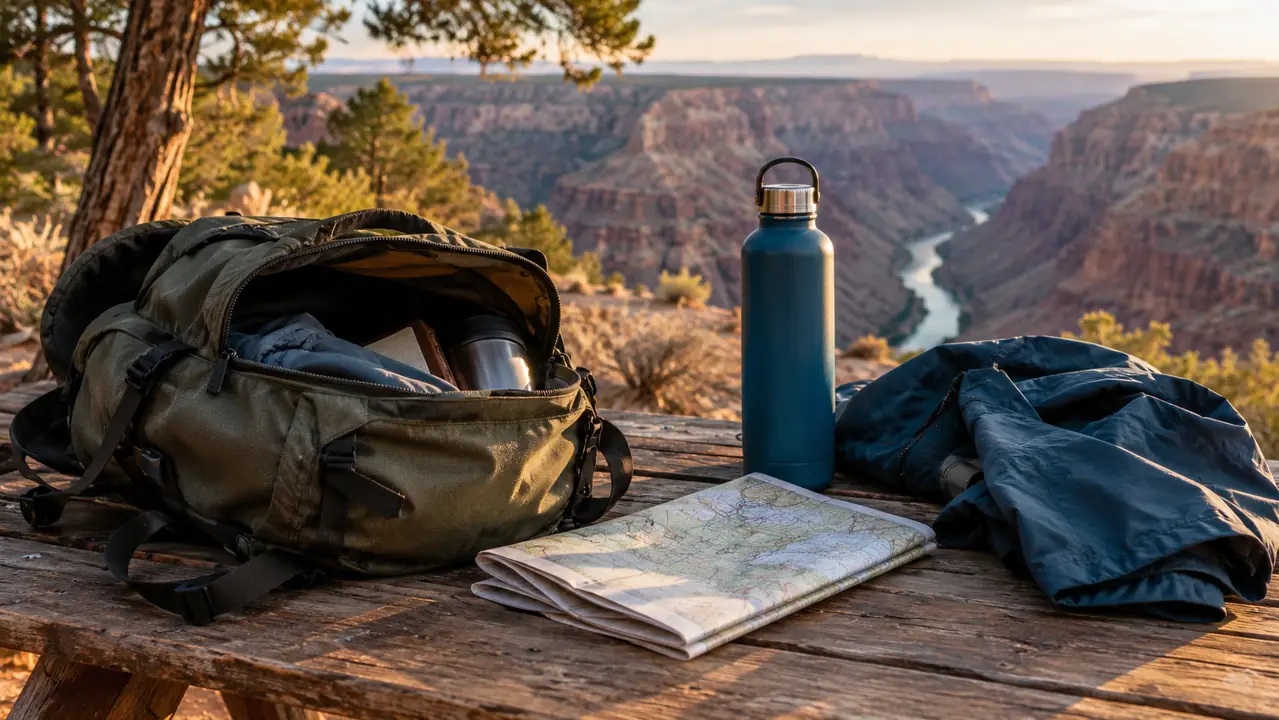
What Nobody Tells You About the Daylite Plus
The biggest thing nobody tells you is that this is a commuter pack that happens to work for day hikes. That sounds like splitting hairs, but it changes how you should judge it. A dedicated daypack might have a beefier hip belt, a more breathable back panel, or a lid pocket. The Daylite Plus has a clean, simple design and a laptop sleeve. It is light because it does not have those extra pieces. When I stopped expecting it to be a technical daypack, I liked it more. When I expected it to carry like one, I was disappointed. The pack did not change. My expectation did.
The second thing nobody tells you is that the light weight is not free. You trade some structure for it. I am not saying the pack is flimsy. It has held up well. I am saying that a 1.3 pound pack with simple backstraps will not carry a heavy load the way a 3 pound pack with a frame will. If your day hikes are 4 to 8 miles and your load is under 12 pounds, you get the benefit of the light weight without the cost. If your load is heavier, you feel the cost in your shoulders. That is the honest math. The Osprey Daylite Plus is a great pack inside its lane. Outside it, you will notice.
The third thing nobody tells you is that the water repellent finish and the recycled polyester are real, but they do not make this a four season pack. I have used it in summer heat and in a cold morning at the Grand Canyon. It handled both. In a steady rain, it got damp. In snow, I would want more. The fabric is 100 percent recycled polyester and bluesign approved, which I like. I also know that a fabric can be responsibly made and still not be the right fabric for a wet climate. Those are separate questions. Osprey made a good choice for a commuter pack. For a rainy trail, bring a cover.
What I Liked
- Light at 1.3 pounds, so it disappears on short hikes.
- Adjustable backstraps fit both me and Ray without fuss.
- Five pockets keep small gear findable.
- Padded sleeve fits up to a 14 inch laptop and protects flat items.
- Water repellent finish sheds light rain.
- 100 percent recycled polyester and bluesign approved.
Where It Falls Short
- Simple backstraps do not carry weight like a load-bearing hip belt.
- Main compartment gets tight once you add a heavy layer.
- Water repellent, not waterproof, so steady rain gets through.
- Spot clean only, which is a chore after muddy trails.
- Laptop sleeve takes space even when you do not need it.
Who This Is For
This pack is for the day hiker who wants a light, simple bag for 4 to 8 miles and does not want to carry the kitchen sink. It is for the person who hikes Red Rock Canyon in the morning and stops at the store on the way home. It is for someone who wants a 14 inch laptop sleeve for travel and does not want a separate commuter bag. It is for a hiker with a healthy back and shoulders who can carry 8 to 12 pounds without a load-bearing hip belt. If that sounds like you, the Osprey Daylite Plus is a sensible choice. It is not the only choice, but it is a good one inside those limits.
Who Should Skip It
Skip it if you need to carry more than 12 pounds on a regular basis. Skip it if you have shoulder or neck issues and rely on a hip belt to take the load. Skip it if you hike in steady rain and do not want to mess with a cover. Skip it if you want a pack that can go from a 4 mile walk to a 15 mile day without changing its character. Skip it if you need a washing machine friendly bag. None of these are insults. They are fit issues. The Osprey Daylite Plus is a light commuter pack that works for short day hikes. If your hikes are longer or heavier, a different pack will serve you better.
If a light 4 to 8 mile daypack is what you need, start here
Check the Osprey Daylite Plus dimensions, pocket layout, and current listing, then compare it to the load you actually carry.
Amazon See the Osprey Daylite Plus on Amazon →